
Sustainable trade fair construction 2026: Modular concepts, reuse and practical tips

Trade fair appearances will be under greater scrutiny in 2026 than just a few years ago. Buyers, trade visitors, and internal stakeholders will no longer simply ask whether a stand looks good. They will also ask how it was produced, how much of it is reused, and whether the budget was planned transparently.
For B2B exhibitors, this doesn't create a contradiction. A high-quality exhibition stand can be visually appealing, functional, and responsibly planned. The crucial point is to integrate sustainability into the design early on, rather than tacking it on as a decorative extra at the end. Thinking modularly, selecting materials carefully, reducing print, and meticulously planning logistics create a better foundation for credible trade fair communication.
Why sustainability will matter more in trade fair construction in 2026
Sustainability in the B2B sector is no longer just a matter of image. Many companies have their own sustainability goals, scrutinize supply chains more closely, and pay attention to resource consumption in projects. Trade fair appearances are part of this, even if they are time-limited.
A trade fair booth only has an impact on the exhibition space for a few days. However, the materials, transport, storage, and disposal behind it have a significantly longer life cycle. That's precisely where the leverage lies. If components are reused, less disposable material is generated, and transport is better planned, the booth becomes not only more resource-efficient but also more predictable.
This is relevant for exhibitors for several reasons:
Procurement will be examined more closely.
Purchasing departments are increasingly asking about reusability, material usage, and transparent costs.
Brand image and attitude must match
A company that communicates responsibility should not appear visibly wasteful at its trade fair booth.
Budgets remain under pressure
Reusable concepts help to distribute expenses effectively across multiple events.
Trade fairs are changing
Flexible formats, changing stand sizes and shorter planning times require concepts that can be adapted.
Sustainable exhibition stand construction therefore does not mean sacrificing impact. It's about achieving the same or better impact with less unnecessary effort.
Modular and reusable stand concepts bring structure to the planning.
A modular exhibition stand is not just a basic construction kit. When properly planned, it combines design, function, and reusability. Elements such as walls, platforms, counters, booths, ceiling frames, and media carriers can be designed to function in multiple exhibition spaces.
The key advantage lies in its adaptability. A booth can look different in a 30-square-meter space than in an 80-square-meter space without requiring a complete redesign. The basic structure remains the same; individual modules are added, reduced, or rearranged.
A reusable exhibition stand is particularly suitable for companies that exhibit regularly. This includes leading trade fairs, specialist conferences, roadshows, or regional events. Initial planning should consider not only the next trade fair, but a short trade fair season or even several years.
What is really important in modular concepts
For reuse to work in practice, clear decisions are needed. Not every component needs to be reused repeatedly. A distinction between durable core modules and variable surfaces is advisable.
Permanent elements can include:
Load-bearing structures and frame systems
reusable wall modules
Floor or platform elements
Furniture, counters and display cases
LED and media technology
Storage cabins or storage modules
Variable elements can be:
interchangeable graphic surfaces
textile coverings
product-specific displays
seasonal content
individual accent areas
This keeps the presentation fresh without having to start from scratch each time. A modular exhibition stand also supports technical planning. Connections, lighting, and media technology can be determined early on. This reduces coordination efforts and minimizes spontaneous changes during setup.

Material selection and waste reduction begin before the first design.
Much waste isn't generated during dismantling. It arises during the planning phase, when a booth is conceived as a one-off piece whose components are hardly usable after a few days. Anyone wanting to avoid waste should ask themselves during the design phase: What can be stored, repaired, re-covered, or reused in a different location?
Materials should be selected based on function, durability, weight, and reusability. It's pointless to choose a material solely for its eco-friendly image if it has to be disposed of after a trade fair or causes unnecessary hassle during transport.
Practical material questions for planning
These questions help to make decisions more tangible:
Can the component be used multiple times?
Can it be disassembled with minimal damage?
Is the surface replaceable without replacing the entire element?
How well can the material be stored?
Is the weight reasonable for transport and assembly?
Can repairs be carried out easily?
Are there alternatives with less waste?
Even details matter. Screw-in connections are often better than permanently glued solutions if components need to be separated or repaired later. Textile graphics can sometimes be stored and replaced more easily than rigid panels. Standardized dimensions reduce waste and simplify the supply of replacement parts.
Sustainable construction thrives on such unspectacular decisions. At first glance, they may seem less spectacular than grand sustainability pledges. In practice, however, they make all the difference.
Less waste also means less complexity.
A stand with many special shapes, disposable surfaces, and short-term changes usually generates more material waste. A clear design with fixed modules, defined graphic zones, and standardized dimensions can be produced more cleanly.
This doesn't mean the booth has to be boring. Impact often arises from spatial design, lighting, good proportions, and clear content. Not every visual signal requires new materials.
Digital content replaces unnecessary print.
Print will not disappear from trade fair construction. Site plans, product cards, or high-quality brochures can still be useful. However, much printed content is produced out of habit and ends up in the trash after the trade fair.
LED displays and digital screens offer a better solution. They make content interchangeable without the need to print new large-format graphics each time. Product innovations, use cases, videos, technical data, or campaign messages can be adapted on-site.
Digital communication is most effective when content is clearly planned. An LED wall is no substitute for a good message; it only makes poor content more visible. Therefore, the content should be integrated with the booth concept from the outset.
Useful examples include:
Short product sequences instead of long image films
Changing content for different visitor interests
clear technical illustrations
subtle movements that provide orientation
QR codes for datasheets instead of stacks of printouts
Digital lead capture, if implemented in compliance with data protection regulations.
The advantage lies not only in less paper. Digital content can accompany multiple trade fairs and be adapted to each target market. This reduces production effort and creates greater flexibility in sales.

Logistics and setup determine the actual efficiency.
A sustainable concept loses its effectiveness if transport, storage, and setup are not considered. Especially with nationwide trade fair appearances, many practical questions arise: How many trips are necessary? How well can components be stacked? What fits into which transport vehicles? Which elements should be set up first?
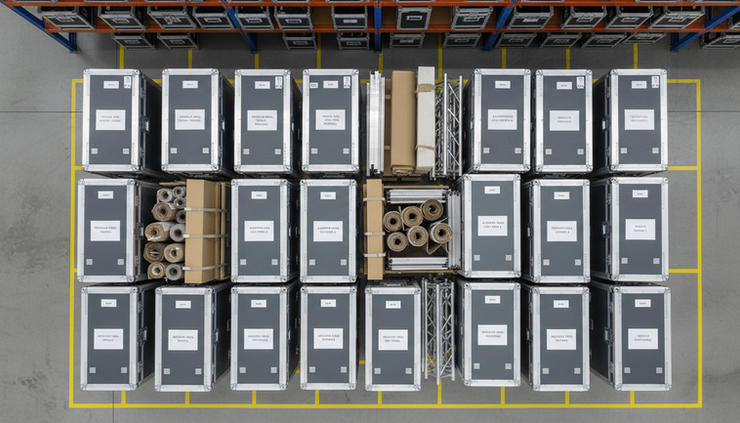
Efficient logistics begins with a booth designed for easy transport. Compact modules, clear packing lists, and robust transport packaging protect materials and save handling time. Properly labeled components also reduce the risk of search times, incorrect assembly, and damage.
Good construction processes avoid stress and rework.
Every hour counts on the exhibition floor. The clearer the design, the smoother the setup. This also has to do with sustainability, because improvised solutions on the construction site often lead to additional material usage, express deliveries, or unnecessary trips.
The following are practically helpful:
Early coordinated technical plans
fixed responsibilities for assembly and electrical work
unique identification of the modules
Recurring setup processes for serial production
realistic time windows for delivery and dismantling
Planning for storage after the trade fair
Repairability is also a factor in efficiency. If minor damage can be repaired after use, the equipment remains usable for longer. This is better than replacing entire components.
Sustainability supports budget control
Sustainability is sometimes seen as an additional cost factor. In exhibition stand construction, this isn't automatically true. Many sustainable decisions contribute to better budget control because they promote reuse, clear standards, and predictable processes.
A completely new booth might seem appropriate in the short term, but it incurs new design, production, and coordination costs for every subsequent appearance. A modular concept distributes investments more effectively. Recurring elements don't need to be procured anew each time. Adjustments focus on content, interfaces, and individual design elements.
This is particularly helpful when several trade fairs are planned per year. The costs per event can be better assessed because storage, customization, transport, and setup are taken into account from the outset.
Fixed-price planning provides more security
For buyers, not only the size of the budget is important, but also its reliability. Unclear scope of services quickly leads to additional costs. Therefore, a trade fair construction proposal should describe as specifically as possible which services are included.
Depending on the project, this includes:
Planning and design
Manufacturing and materials
transport
Setup and dismantling
Electrical and media technology
Graphic production
Storage and reuse
Service during the trade fair
A clear fixed-price plan not only supports the commercial side of things. It also forces a precise project definition. This reduces spontaneous changes and helps to consistently implement sustainable decisions.
Credibility is built through concrete measures, not greenwashing.
Sustainable communication only works if it remains verifiable and reasonable. Exaggerated claims, unclear statements, or fabricated awards do more harm than good. Trade fair visitors and procurement teams quickly recognize whether a booth concept has substance.
Simple, verifiable language is better. Instead of speaking generally about a "green trade fair booth," specific measures can be named:
Which elements are reused?
What materials are being stored?
Which print areas were reduced?
Which content is available digitally?
How is the booth planned for multiple events?
Which parts can be repaired or replaced?
This information appears credible because it is verifiable. No one needs to claim perfect sustainability. In trade fair construction, it's often about progress in many individual steps. That's precisely what makes it credible.
Credible sustainability in trade fair construction begins with decisions that continue to have an impact after the trade fair.
This approach also helps internally. When sales, purchasing, marketing, and exhibition stand construction partners work with the same facts, fewer misunderstandings arise. The stand is not only better documented but also better managed.
This will make your trade fair stand more practical and future-proof in 2026.
A future-proof booth concept isn't created by a single material change. It arises from the interplay of modular planning, appropriate material selection, reduced print volumes, digital content, efficient logistics, and transparent costs.
For the next planning stage, a quick reality check is worthwhile:
Which parts of the booth will continue to be used after the trade fair.
For which trade fair sizes does the concept need to work?
Which content can be used digitally instead of in print?
Which materials are easy to store and repair?
Which services must be clearly included in the offer?
Which sustainability claims can be specifically substantiated?
Addressing these questions early on creates a better foundation for design, purchasing, and implementation. This prevents the stand from being retrofitted to be more sustainable; it ensures it is sensibly planned from the outset.

If you're planning an exhibition stand that combines impact, reusability, and budget transparency, CA Messebau offers further information on professional stand construction . You can request a customized exhibition stand construction quote directly for a specific project.
Sustainable trade fair construction in 2026 is not about sacrifice. It's about good planning. Those who reuse modules, select materials more consciously, utilize digital content, and plan costs transparently create a presentation that is professionally convincing and performs better in the long run.


Comments