
Presentation stand: compact, professional and clearly planned
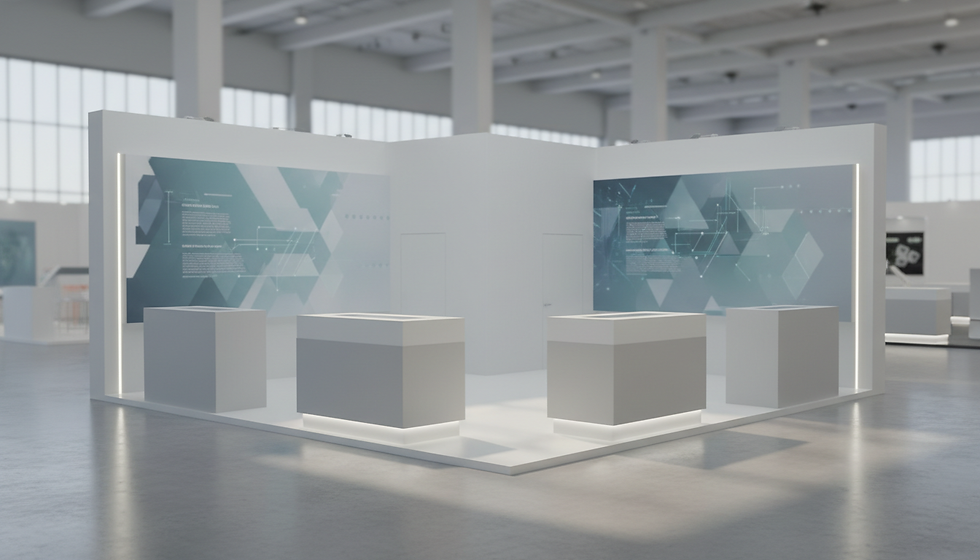
A presentation stand is the compact solution for exhibitors who want to clearly separate brand, product, and conversation area in a small space. It is not a scaled-down version of a large stand. It must be easier to understand, guide visitors more effectively, and require fewer elements.
For many SMEs, a booth area of between 9 m² and 20 m² is sufficient if it's well-planned. Clear priorities are crucial. What should be visible? Where will the first contact take place? Where can a brief conversation be held? What does the team really need on-site?
A large brand presence often incorporates multiple themes, wide aisles, lounge areas, and strong visual impact from a distance. A compact exhibition stand operates differently. It requires a clear message, well-placed graphics, lighting, and intuitive visitor guidance. This is precisely what creates professionalism.

Planning a presentation stand: area, zones and equipment
A presentation stand works particularly well in typical trade fair spaces ranging from 9 m² to 20 m². At 9 m², every meter counts. At 12 m², a clear layout with a reception area, product display, and a small consultation corner is already possible. At 20 m², there is more space for exhibits, storage, or two simultaneous conversations.
The three basic zones are simple:
Reception
The counter is prominently located in the corridor. It serves as a meeting point, storage area, and orientation point. It shouldn't be too large, otherwise it will obstruct the overall effect.
product
A product, sample, or demo module needs a fixed position. This space should not be in the way. Visitors need to be able to see the exhibit without being forced directly into the booth.
Conversation
A small seating area or a standing table is often sufficient. A small trade fair booth is usually not intended for lengthy consultations. The goal is a qualified discussion and a clear next step.
What doesn't belong in the booth space? Too many exhibits, large storage areas, heavy furniture, wide counters, and multiple equally important messages. These things make the booth feel cramped. Technical equipment should also be appropriate for the space. A large wall installation can quickly overwhelm a small area.
When searching for "trade fair presentation stand," one point is particularly important: the stand must be conceived within the context of the hall layout. Aisle orientation, neighboring stands, power outlets, ceiling height, and sightlines determine what works. A design on paper is rarely sufficient for this.
Design rules for small exhibition stands
In small spaces, design has a more decisive impact than in large booths. There's less room to conceal weaknesses. Good design doesn't make the booth feel cluttered; it makes it clearer.
One message is enough
A compact trade fair booth needs a central message. This should be legible from a few meters away. A single sentence, a product benefit, or a clear description of services is sufficient. A logo, a key visual, and a few bullet points can also be used.
Avoid large blocks of text that no one reads in passing. Trade fair visitors scan. They'll stop if they immediately understand what it's about.
Light makes a surface more valuable
Light is not an add-on. It directs the eye and creates depth. At small booths, the product, graphics, and counter should be specifically illuminated. Cold, harsh hall lighting alone often makes surfaces appear flat.
Useful examples include:
spotlights on exhibits
indirect light on back walls
Accent lighting at the counter
uniform illumination of the graphic surfaces
The counter must not block everything.
The counter is important, but it shouldn't obstruct access. A narrow counter at the edge appears more open than a large counter in the middle. If storage space is needed, it should be integrated into the counter or a back panel.
The graphics must work from a distance.
Graphic displays shouldn't look like brochures. Large images, short texts, and high contrast are more effective. QR codes can be useful, but they don't replace a clear message at the booth.
A good presentation stand doesn't show everything. It shows the right things in the right size.
LEDs, yes, but appropriately sized for the area
Moving content attracts attention. In small spaces, a compact LED element or a small screen is often sufficient for product videos, short sequences, or application examples. A complete LED wall isn't always practical if the budget is tight or the floor space is too small.
CA Messebau also offers LED video wall rentals . For small booths, however, the technology should always be appropriate for the intended purpose. Not every space requires the largest solution.

Which construction method is suitable for a presentation stand?
The construction method determines price, impact, reusability, and design flexibility. For small spaces, there are three sensible approaches: prefabricated systems, hybrid construction, and custom-built structures.
CA Messebau from Duisburg offers full-service stand construction in all three variations. This includes design, 3D concepts, project management, and implementation as system construction, custom construction, or hybrid construction.
Construction | Suitable for | Typical strength |
System status | Clear, economical presentations with fast planning | good structure, clean foundation, predictable construction |
Mixed construction | Floor spaces that combine standard and individual elements | good ratio of effect to effort |
Custom-built | special shapes, special materials, or strong independence | maximum design freedom |
A modular booth system is a good choice when the space needs to be clearly structured, the message simple, and the budget tight. Modern systems don't automatically appear simple. Clean graphics, lighting, and high-quality surfaces are crucial.
Hybrid construction is often the strongest solution for a presentation stand. It combines an economical basic structure with individual elements. This could be a special counter, a striking back wall, or an integrated product area.
Custom stand construction is worthwhile if the stand requires a special shape, a specific product presentation, or a significantly different spatial effect. However, on a small footprint, custom construction must be planned very precisely. Otherwise, the stand can quickly appear cluttered.
3D concepts are helpful for planning. CA Messebau creates a free 3D design. Important: These 3D images are concepts for planning and coordination, not finished references. This allows you to check proportions, pathways, and sightlines before making any decisions.
You can find more information about the design in the Design & 3D section.
Costs for a compact exhibition stand
Costs depend on the size, construction method, materials, technology, graphics, location, trade fair requirements, and logistics. Lucrative, all-inclusive offers are rarely helpful because they often fail to include essential services. A fixed price based on a clear briefing is a more reputable approach.
CA Messebau cites the following as guidelines for examples:
Example | Zone A | Zone B |
Compact, 12 m² row stand | from €5,800 | from €6,400 |
20 m² corner stand if more space is needed | from €9,000 | from €9,800 |
These figures are examples. The actual price depends on the planned scope. A 12 m² exhibition stand with simple graphics and system elements will cost differently than a stand with custom construction, additional lighting accents, or media technology.
The scope of services is crucial. CA Messebau offers free 3D design and a fixed-price guarantee. This provides security before you place an order. You can see the concept, review the specifications, and receive a clear price quote.
The process takes place in four steps:
Clarify briefing and objectives
Area, trade fair, target group, product, budget and technical requirements are collected.
Create a free 3D design
The 3D concept shows the structure, zones, paths and basic effect.
Agree on a fixed price offer
Features, construction methods, and services are defined. This forms the basis for the price.
Project management and implementation
CA Messebau coordinates the planning and accompanies the implementation up to the trade fair appearance.

Checklist for a professional appearance
A small booth becomes professional when the details come together. These ten points will help with preparation:
Set a goal
Is it about new contacts, product presentations, dealer discussions, or recruiting? Having a goal leads to better decisions.
Shorten the main message
Formulate a statement that can be understood in a few seconds.
Realistically utilize the space
Plan the reception area, product zone, and conversation area. Leave clear pathways.
Limit exhibits
It's better to clearly display one strong product than to show several products crammed together.
Place the counter correctly
The counter is meant to invite, not exclude.
Plan for storage space
Bags, brochures, packaging, and technical equipment all need space. Open boxes look unprofessional.
Use light strategically
Highlight the product and graphics. This will make the stand stand out from the hall lighting.
Make graphics legible
Large font, short text, clear contrasts. Not a brochure on the wall.
Choose the right technology
Small LED or screen solutions can be useful. The available space determines the size.
10. Clarify structure and responsibilities
Project management, deadlines, approvals and trade fair specifications must be clarified early on.
A presentation booth doesn't need cluttered equipment. It needs decisions. The clearer the choices, the stronger the impact.

FAQ about the presentation stand
What size is suitable for a small trade fair appearance?
Typical sizes range from 9 m² to 20 m². A clear layout with a reception area, product display, and a small consultation zone can be planned on 12 m². 20 m² provides more space for exhibits or parallel conversations.
Is a system state professional enough?
Yes, if the design, lighting, graphics, and furnishings are well-planned. A modular booth can look very neat. For more individuality, a hybrid construction can be a good option.
When does an LED solution make sense?
LED lighting is worthwhile when moving content better explains a product or attracts attention. With a tight budget, a small screen is often more practical than a large wall.
What distinguishes a 3D concept from a reference?
A 3D concept shows the planned state before implementation. It serves to coordinate proportions, zones, and design. It is not a finished reference.
How does the inquiry process work at CA Messebau?
You send us data about the trade fair, the exhibition space, and your objectives. This is followed by a briefing, a free 3D design, a fixed-price quote, and project management for the implementation.
Plan clearly, then present a compact image
A presentation stand looks professional when it doesn't try too hard. A clear message, well-defined zoning, good lighting, and appropriate construction are often sufficient. Especially with 12 m² or 20 m², the planning determines the impact.
CA Messebau from Duisburg supports exhibitors with full-service stand construction, design and 3D concepts, project management, system construction, individual construction, mixed construction and, on request, LED video wall rental.
If you are planning a compact booth with a clear price basis, request your concept here: request a free 3D design with a fixed price guarantee .
Direct contact: +49 173 730 78 45 or info@ca-messebau.de.


Comments