
Custom stand construction for your trade fair stand: When custom work pays off
Meta description: Custom stand construction for discerning brands. Comparison, use cases, hybrid construction methods, process, cost logic, and FAQs.
Custom stand construction means a trade fair stand that is 100 percent tailored to the brand, objectives, and available space – not a standard shelf with a logo. For companies with high brand aspirations, this is often the difference between "we're there too" and a presentation that sparks conversations.
A trade fair booth doesn't always have to be custom-made. A professional modular system booth can be the right choice for many purposes. The crucial question is what the booth is intended to achieve. If the goal is visibility at a leading trade fair, a clear corporate identity, product presentation, numerous open sides, or complex visitor guidance, then a custom-built booth quickly becomes relevant.
CA Messebau from Duisburg offers a full range of services for exhibition stand construction. This includes consultation, free 3D design, planning, project management, and implementation with a fixed-price guarantee. You can find more information about the general scope of services in the Stand Construction section.

Individual stand construction or system stand: a clear comparison
Choosing the right booth type depends on more than just the budget. Brand impact, timeline, reusability, and technical requirements all play a role. The following overview highlights the key differences.
criterion | Individual status | System status | Mixed construction |
Brand impact | Very high. The stand will be unique, CI-compliant, and can be planned from a presentation stand to a complete brand experience. | Professional and clean. The design remains more strongly tied to grids, module dimensions, and system logic. | High. The system base provides structure, individual elements create the unique look. |
budget | A higher proportion of planning and manufacturing. Makes sense if the presentation plays a central role. | Efficient, flexible, and budget-friendly. Ideal for clearly defined trade fair objectives with manageable design requirements. | Often the best middle ground. A system base plus timber construction, special areas or special LED solutions achieve results within a controlled budget. |
Timeline | It requires more lead time for concept development, coordination, manufacturing, and technical clarifications. | Shorter planning processes because many components are tried and tested and available in modular form. | Usually faster than a fully customized stand, but with more coordination than a purely system-based stand. |
reuse | Possible if components are designed modularly and planned for easy storage. | Very good, as system elements can be adapted for changing surfaces. | It's good when individual components are specifically designed for multiple uses. |
A modular stand is not the "small solution". It is efficient, flexible, budget-friendly, and professional. For many trade fair appearances, it's exactly the right choice.
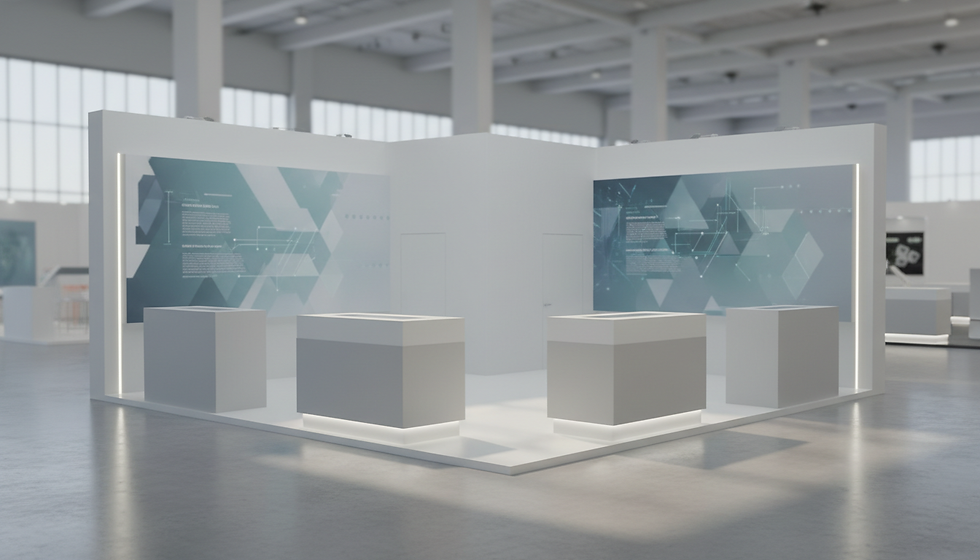
Custom stand construction is the ideal choice when the stand itself becomes a strategic tool. A bespoke exhibition stand can seamlessly integrate products, architecture, lighting, materials, and conversation zones to create a cohesive and compelling overall impression.
Hybrid construction lies in between. It utilizes a system base and complements it with individual elements made of wood, special surfaces, or dedicated LED panels. This results in a high-quality appearance with more manageable costs.
When an individual stand is the right decision
A custom-designed booth is worthwhile if the trade fair is of high importance for sales, branding, or product launches. This is especially true for leading trade fairs, where competitors are often located very close to one another. Visitors compare presentations within seconds. A standard layout is rarely sufficient if a brand needs to be clearly recognizable.
Custom stand construction is particularly useful in these situations:
High corporate identity standards: Colors, shapes, materials, and lighting must precisely match the brand. This applies not only to wall graphics but to the entire space.
Many open sides: With end stands, corner stands, or island stands, the exhibition stand can be viewed from multiple directions. The architecture must work from all sides.
Complex products , machines, samples, exhibits or solutions requiring explanation need suitable presentation areas, safe routes and clear viewpoints.
Separate zones for consultation, reception, product demonstration, lounge, storage, and media areas should not be randomly located next to each other. They must be logically arranged.
Strong long-range visibility : Orientation is crucial in large halls. Height, lighting, suspended ceilings, LEDs, and clear shapes help to identify the stand early on.
A presentation stand can be planned in a very minimalist way. A brand experience, on the other hand, can be significantly more comprehensive, with spatial design, a material concept, media integration, and multiple discussion areas. The focus is not on "building more." The focus is on fit.

Custom stand design is also helpful when the stand needs to reflect specific workflows. For example, a reception area for quick orientation, a demo area for brief product discussions, and a secluded area for confidential meetings. These pathways can be guided more precisely in a freely designed stand than in a fixed grid.
Lead time is crucial. Custom work requires decisions. The clearer the goals, space requirements, corporate identity guidelines, and trade fair deadlines are, the better the concept can be planned.
When mixed construction is smarter
Not every high-quality presentation requires a purely custom-built stand. A hybrid design is often the better solution when impact and budget need to align.
The principle is simple: The basic structure consists of proven system elements. These are supplemented with individual components. These can include wooden surfaces, custom counters, special LED elements, lighting contours, or striking wall sections. The stand has a unique look without requiring every component to be custom-made.
Mixed construction is particularly suitable when:
Several trade fair appearances with varying floor space sizes are planned.
The stand should appear professional and high-quality.
Individual areas are to be heavily staged.
Set clear limits on budget and timeline
an existing system is to be expanded with individual elements
An example without a case study: A company is planning a 50 m² booth with a reception area, two consultation zones, and a product wall. The basic structure can be designed as a modular system. A custom-made wooden wall, a striking lighting strip, and a rented LED video wall create the defining features. This results in a distinctive look with a budget-friendly approach.
For many B2B trade fairs, this is precisely the sensible approach. System stands deliver efficiency. Individual elements add character. Custom stand construction therefore doesn't always have to mean "everything is custom-built." Often, the best stand results from the right mix.
How CA Messebau guides you to your stand in 4 steps
A good exhibition stand isn't created by a beautiful sketch alone. It's built on sound decisions, clear responsibilities, and reliable execution. CA Messebau in Duisburg works as a full-service partner, guiding the process from the initial concept to completion.
1. Consultation and goal clarification
The starting point includes determining the floor space, trade fair objectives, budget, corporate identity guidelines, and technical requirements. The central question is: What should the stand achieve?
Is the goal to establish new contacts, present products, schedule meetings, increase visibility, or a combination thereof? The answers to these questions will determine whether a system stand, an individual stand, or a hybrid design is the most suitable option.
2. Free 3D design
Based on the requirements, a free 3D design is created. This is a planning concept, not a finished reference model. It visualizes how space, pathways, materials, lighting, and media surfaces interact.
You can find more information about the design process under Design in Exhibition Stand Construction .

3. Planning with a fixed price guarantee
Following the agreement, the detailed planning begins. This includes stand construction, technology, logistics, assembly, and coordination with relevant trade fair regulations. The fixed-price guarantee ensures cost certainty for the agreed scope of services.
This is particularly important when internal budgets need to be approved. Custom stand construction often involves several cost categories. A clear fixed price reduces later disputes.
4. Project management until handover
The project management team coordinates trades, schedule, setup, and handover. Especially with custom components, LED integration, or multiple functional zones, a reliable control system is crucial. You can find more information in the Project Management section.
For trade fair organizers, this means fewer interfaces. One contact person handles planning, queries, and implementation.
How the cost logic works in custom-made products
Simply looking at square footage isn't enough when designing an exhibition stand. Two stands with the same area can have completely different requirements. A 20-square-meter stand with custom construction, LED lighting, storage space, and multiple exhibits can be more complex than a larger, but simpler, space.
The costs arise primarily from these factors:
Stand type and construction
Material selection and surfaces
Special construction component
Lighting and media technology
Height and long-range effect
Number of functional zones
Assembly costs and logistics
Reusability and shelf life
Therefore, CA Messebau provides fixed-price examples for 20 m² or 50 m² as guidelines, not as a rigid square meter formula. It is always advisable to request a quote based on your objectives, the required area, and the desired features.
Custom stand construction is a worthwhile investment when the stand demonstrably meets the trade fair requirements. An overly planned stand ties up resources unnecessarily. A stand that is too simple can miss opportunities. The ideal design lies somewhere in between, depending on the objective.
LED video wall as a rental solution
An LED video wall can significantly enhance the visual impact of an exhibition stand. It is suitable for moving images, product content, process demonstrations, or visual wayfinding within the hall. CA Messebau offers the LED video wall as a rental solution .
The combined advantage is clear: When the booth and LED lighting are booked together, LED transport and logistics are free. This reduces interfaces and simplifies planning.
A video wall is no substitute for a good booth design. It should be positioned where it effectively engages visitor flow and doesn't disrupt conversations. With custom booth construction, this position can be planned early in the spatial concept.

FAQ about individual stand construction
When does individual stand construction really pay off?
It's worthwhile if the exhibition stand plays a high strategic role. Typical examples include leading trade fairs, strong corporate identity guidelines, many open sides, product displays, or complex conversation areas. In these cases, a standard stand design is often insufficient.
Is a system state automatically of lower quality?
No. System stands are efficient, flexible, budget-friendly, and professional. They are well-suited when clear objectives, short timeframes, or changing spaces are paramount. Their effectiveness depends heavily on planning, graphics, lighting, and execution.
What are the advantages of mixed construction methods?
Hybrid construction combines a system base with individual elements. Wood, special surfaces, or custom LED solutions create a unique look. At the same time, the budget remains more manageable than with a completely custom-built structure.
How early should the planning begin?
As early as possible, especially for leading trade fairs, custom construction projects, LED displays, or specific technical requirements. Early planning improves coordination, material selection, and permitting. Even a free 3D design requires clear initial data.
Can a custom-designed exhibition stand be reused?
Yes, if reuse is considered from the outset. Modular components, storable elements, and flexible dimensions help with this. This applies to custom-built stands as well as hybrid and system stands.
The next step towards the perfect exhibition stand
Custom stand construction isn't just a matter of size. The crucial factor is the stand's intended purpose. For a clear, professional trade fair appearance, a modular stand may suffice. However, for strong brand impact, complex spaces, and demanding corporate identity requirements, a custom-designed stand is often the better choice. Hybrid construction offers an economical middle ground with a distinctive character.
If you would like to check which stand type suits your trade fair, space and objectives, you can request a quote directly: request a free 3D design and fixed price quote from CA Messebau .
You can reach CA Messebau by phone at +49 173 730 78 45.


Comments