
Row stand, corner stand, headstand or island stand – which stand configuration suits you best?
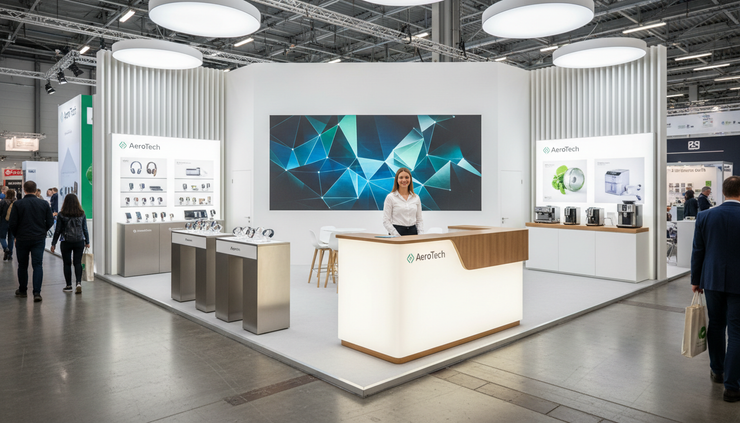
The stand design often determines the success of a trade fair earlier than many exhibitors realize. Even before exhibits, graphic surfaces, or meeting rooms are planned, it dictates how visible your presence is, how visitors flow past your stand, and how much space you need to actively utilize.
Those choosing between a row stand, corner stand, end stand, and island stand are always weighing two things: visibility and budget . More open sides usually mean greater visibility and more access points. At the same time, the demands on design, staffing, technology, and stand construction generally increase. Therefore, the best solution isn't automatically the largest or most open space, but rather the stand shape that best suits your objectives.
CA Messebau realizes all common layouts, from classic in-line stands to freestanding island stands. In the quotation form, you can choose between an island stand, three open sides, two open sides, or one open side. This allows you to clarify early on which basic layout you are planning and how to create a cohesive trade fair presentation.

What stand design means for your trade fair appearance
A trade fair booth layout describes how your booth is positioned in the hall and from which sides visitors have access. This has direct implications for planning and impact.
A stall with one open side functions differently than one with four open sides. In a row stall, contact is usually made via the front. An island stall can be accessed from all directions. Corner stalls and end stalls fall somewhere in between, offering greater visibility but also requiring more meticulous planning.
For practical purposes, the following questions are particularly relevant:
How many pages are open and visible?
On which routes is the stadium located?
Where do natural contact points occur?
How much long-range impact does the brand or product need?
How many employees can effectively staff the booth?
Should the stand primarily inform, advise, sell, or present?
The answer to this question not only affects the floor space. It also determines whether a modular system stand , a custom-designed exhibition stand, or a hybrid structure is more suitable. The exhibition stand design is also closely linked to the stand's shape, because graphics, lighting, exhibits, reception areas, and meeting zones are arranged differently depending on the open side.
A comparison of the four standing positions
The following overview shows the basic logic of the four most common booth layouts. It does not replace concrete planning, but helps with an initial assessment.
Standing form | Open pages | visibility | Cost trend | Typical strength |
Lineup | 1 | Low to medium | Rather low | A compact, clearly structured presentation. |
Corner stand | 2 | Medium to good | Medium | More contact area with controlled planning |
Headstand | 3 | Good to very good | Rather higher | Strong presence at intersections or front lines |
Island stand | 4 | Very high | Higher | Maximum openness and long-range impact |
The cost trend does not refer to hall fees or specific stand rentals. Such costs depend on the organizer, the trade fair, the hall, and many other factors. What is meant here is the typical planning and construction effort: More open sides usually require higher visible quality, more walkable space, more lighting, more furniture, more staff, and well-thought-out visitor management.
The row stand is compact and easy to control.
The row stall has one open side. Other stalls usually border it on the left and right, while the back is closed or serves as a wall. This layout is particularly common because it is easy to plan, clear, and efficient.
A row booth is ideal if you want a compact presence and wish to present your message clearly and concisely. Visitor flow is straightforward. Anyone passing by sees your frontage, main graphics, reception area, and key exhibits at a glance.
Visibility depends heavily on the location in the aisle. A stand in a row along a busy walkway can be very effective. At the same time, it offers fewer natural contact points than a stand with several open sides. Therefore, the front design is particularly important.
Suitable targets for a line stand
Presence at trade fairs with a clearly defined audience
Product information in a limited space
First appearance or regular participation with a manageable budget
Focus on consulting, samples, exhibits or lead capture
Quieter conversations with controlled access
Precision is key in the design. A clear message, good lighting, and an inviting reception area are more important than numerous individual elements. In modular construction, a row of stands can often be implemented very economically. In custom-built structures, it can appear particularly high-quality when materials, graphics, and spatial depth work well together. A hybrid construction combines both, for example, using modular elements for structure and custom components for brand impact.
The corner stand offers more access and greater presence
A corner stall has two open sides. It is located at the end of a row of stalls or at a crossroads. This makes it visible from two directions and allows it to attract visitors more effectively than a traditional row stall.
For many exhibitors, the corner stand is a good middle ground. It offers greater visibility and flexibility, yet remains manageable compared to more open layouts. Two open sides also mean that reception, exhibits, and graphics cannot function solely on one side. The stand must be responsive to both directions of foot traffic.
A common planning mistake is treating one page as the main page and using the second only incidentally. A better approach is to give both open pages a clear purpose. One page can be designed more for long-distance impact, the other for direct contact. This creates a booth that not only stands out but also guides visitors effectively.
Suitable targets for a corner kick
More visibility without maximum openness
Products that require explanation
Contact from two directions
Combination of presentation and consultation
Trade fair participation with a stronger brand presence
The cost is usually higher for a row stand because more sides need to be designed. However, you gain additional contact area. With good planning, a corner stand can be very efficient because it strikes a good balance between attention and budget.
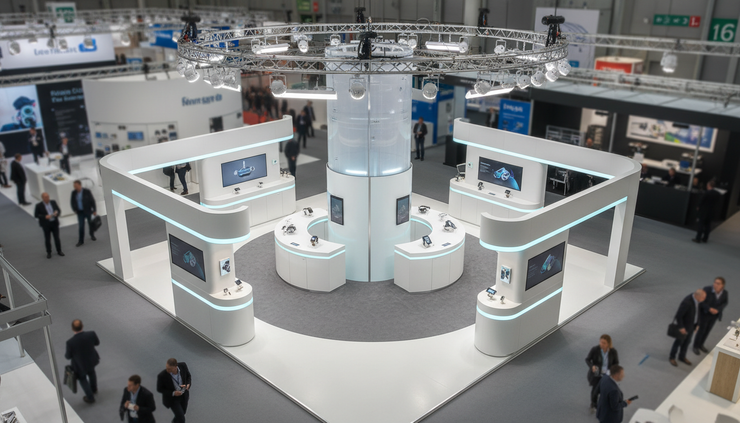
The headstand creates a strong effect with three open sides
A headstand booth has three open sides. It's located at the end of a row of booths and is visible from several directions. Anyone planning a headstand booth at a trade fair gains significantly more visibility than with a row or corner booth. At the same time, the demands on the spatial concept and customer service increase.
Three open sides mean that visitors can enter from multiple directions simultaneously. This can be an advantage if you want to generate many contacts. However, it can become confusing if the reception area, exhibits, and meeting areas are not clearly arranged.
In a headstand design, the back wall shouldn't simply be seen as an end. It can serve as a strong branding element, storage space, media wall, or backdrop for exhibits. The open sides should be planned so that pathways aren't blocked and visitors intuitively know where to start.
Suitable targets for a headstand
High visibility with limited back panel
Presentation of multiple products or topics
Actively engaging with many visitors
Brand presence with a clear long-range impact
Combination of open reception and protected conversation zones
The costs tend to be higher than for a corner booth. Three visible sides require consistently good design. Furthermore, the team needs to monitor the booth from multiple angles. Those who plan for too few booth staff quickly miss out on potential. A corner booth is particularly worthwhile if your trade fair team actively engages with visitors and the booth effectively incorporates multiple contact points.
The island location is vacant and requires a clear concept.
The island stand is open on all four sides. It stands freely in the hall and offers maximum accessibility. An island stand can have a very strong impact from a distance because it is not surrounded by neighboring stands. This makes it the most open and often the most prestigious stand type.
Its greatest strength is also its greatest challenge. Four open sides mean there's no traditional back. Everything is visible. Storage, technology, booths, exhibits, and seating areas must be planned so that the stand looks good and functions well from every angle.
An island booth is particularly suitable if you want to showcase a strong brand presence, present larger exhibits, or conduct many conversations simultaneously. This format can also be beneficial for companies with multiple business units, as it allows for the creation of themed islands or open zones.
Suitable destinations for an island beach
Maximum long-range effect in the hall
Large exhibits or those requiring explanation
Many parallel contacts
Representative brand appearance
Open experience or product areas
Trade fair appearance of high strategic importance
Costs tend to be higher because the stand needs to be designed from all angles. It requires more lighting, more spatial structure, and usually more staff. However, island stands offer the greatest design freedom. Especially in custom-built or mixed-use structures, striking architectural solutions can be developed without the stand being restricted by neighboring spaces.
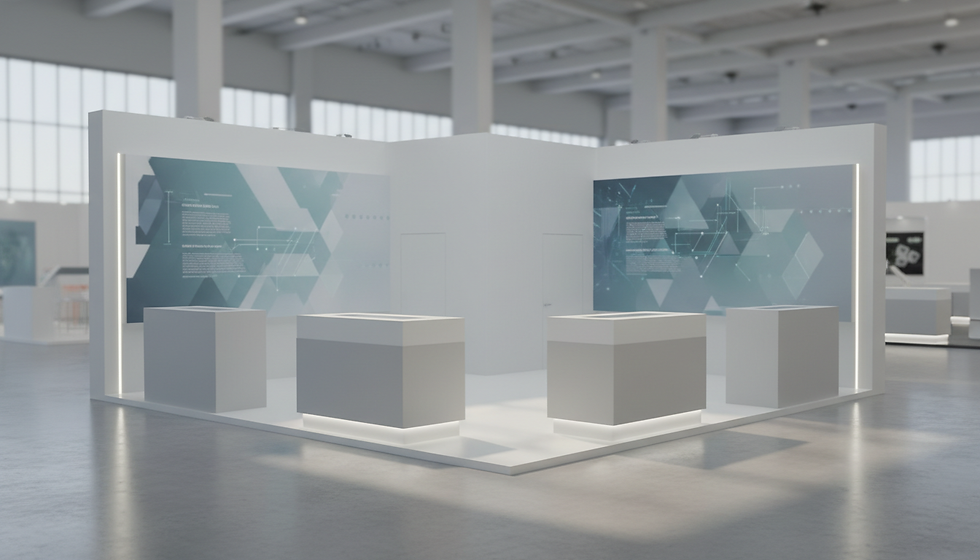
Correctly assess visibility and visitor flow
More open sides mean more opportunities for contact. But they also mean more complexity. A highly visible booth must not only attract visitors, but also guide them. Otherwise, unclear pathways, blocked entrances, or empty zones will result.
Three simple criteria help with the evaluation.
Remote effect
How early will your stand be noticed? Tall structures, lighting, clear graphics, and open sightlines all play a role here. With a row stand, the long-range impact is usually concentrated on the front. With an island stand, it needs to be visible from multiple directions.
Contact points
Where does the initial dialogue begin? A reception desk directly on the only open side can be useful for a row stand. For end-of-stand or island stands, several easily accessible contact points are often needed to prevent visitors from wandering aimlessly through the stand.
Quality of stay
How long should visitors stay? For brief product interactions, an open presentation area is sufficient. For confidential discussions, technical consultations, or contract negotiations, you need quiet zones. The more open the booth, the more specifically these areas need to be protected.
The decision is therefore not solely a matter of floor space. A small corner stand can work better than a larger headstand if the goals, design, and personnel are a better fit.
Which booth design suits which trade fair objective
The correct stance depends on your goal. Clearly defining your goal usually leads to faster and more confident decisions.
If you want to be present efficiently
A row stand is often the right choice. It concentrates budget and design on a strong frontage. This is suitable for companies that exhibit regularly but don't need a very large area.
If you want more attention with controlled effort
A corner booth is often ideal. It offers greater visibility than a row booth while remaining easy to navigate. For many B2B exhibitors, this is a very good compromise between impact and effort.
If you want to actively generate many contacts
A headstand layout offers three open sides and therefore more opportunities for interaction. It's suitable if your team actively engages visitors and wants to present several topics simultaneously.
If you are planning a strong lead appearance
An island stand is suitable for large brand presentations, product launches, or high-profile trade fair participation. It requires a consistent concept, sufficient staff, and meticulous execution from all perspectives.
How individual construction, system construction and mixed construction fit the standard form
The floor plan defines the basic spatial concept. The construction method determines how this concept is implemented.
A modular system stand uses reusable components. It is particularly suitable if you require clear structures, short setup times, and an economical solution. Row stands and corner stands can be easily implemented with this system.
A custom-designed stand is planned and built specifically for your event. It's ideal when architecture, material impact, or a unique product experience are the main focus. End-of-the-wall and island stands often benefit from this approach, as they offer more visible surfaces and greater design freedom.
A hybrid construction combines both approaches. System elements create structure and cost-effectiveness, while individual components add distinctive touches. This is particularly practical if you plan recurring trade fair appearances and still want to achieve a unique impact.
CA Messebau plans and builds all layouts using these construction methods. These include in-line stands, corner stands, end stands, and island stands. The Stand Construction section provides an overview of the implementation possibilities, while Design demonstrates how form, graphics, lighting, and spatial effect come together.

Planning tips for making a decision using 3D design
A stand layout can be assessed on the hall plan. However, it only becomes truly tangible in the 3D design. This is precisely where it becomes clear whether sight lines are correct, whether visitor paths are logical, and whether the open side creates the desired effect.
CA Messebau creates a free 3D visualization upon request and works with a fixed price. This gives you planning security before you make final decisions on the details. A 3D view is particularly helpful when comparing different stand designs because it shows not only the square footage but also the spatial effect.
When planning, pay attention to these points:
Use open pages consciously
Every open side needs a purpose. Reception, exhibit, eye-catcher, or access point should be clearly defined.
Do not lead visitors into walls
Paths must be intuitive. Anyone entering your stall should immediately know where they can go.
Plan storage space early on.
Bags, electronics, brochures, and personal items all need space. With open display stands, storage space must be integrated particularly neatly.
Plan staff realistically
More open pages mean more contact points. If there aren't enough staff on-site, opportunities go unused.
Do not overload the graphics.
A few clear statements are more effective than many short texts. This is especially true when dealing with large numbers of visitors who only have a few seconds of attention.
Manage project execution smoothly
The stand's shape, design, technology, logistics, and construction are all interconnected. Professional project management ensures that decisions are made and implemented in a timely manner.
If you already know whether you're planning 1, 2, 3, or 4 open sides, you can specify this in the quote request form . The form asks for options such as island layout, 3 open sides, 2 open sides, and 1 open side. This simplifies the initial assessment and speeds up the planning process.
Frequently asked questions about row stalls, corner stalls, head stalls and island stalls
Which stand design is best suited for small budgets?
For a limited budget, a row of cabinets is often the obvious starting point. It has only one open side and can be designed very precisely. The key is to plan the frontage to be strong and clearly defined.
Is a corner stall always better than a row stall?
Not automatically. A corner booth offers greater visibility and two entrances. However, if your concept, staff, or exhibits aren't suited to it, a well-planned in-line booth can be more effective.
When is a headstand worthwhile?
A reverse stand is worthwhile if you want to increase your visibility and attract visitors from multiple directions. For this to work, your stand team should be proactive and the stand should offer clear points of contact.
What is the biggest challenge when staying on an island?
The island stand has no traditional back. Every side is visible. Therefore, storage space, technology, exhibits, and conversation areas must be planned with particular care.
Can CA Messebau implement all stand designs?
Yes. CA Messebau plans and builds in-line stands, corner stands, end stands, and island stands. Depending on the goal and budget, implementation can be as a custom-built structure, a modular system, or a hybrid construction.
The best booth is the one that suits the goal, space, and budget.
Row stands, corner stands, end stands, and island stands serve different purposes. Row stands are compact and easy to maneuver. Corner stands offer greater access and visibility. End stands provide a strong presence with three open sides. Island stands create maximum openness and long-range impact.
The most important decision is not which booth design attracts the most attention. The crucial factor is which design best supports your trade fair objectives and can be realistically implemented given your budget, team, and content.
If you would like to compare your stand design and receive a detailed plan with a 3D design and fixed price, you can request a quote from CA Messebau here. Simply specify whether you are planning an island stand, a stand with 3 open sides, 2 open sides, or 1 open side.
Meta Title: Row stand, corner stand, end stand or island stand? Comparison | CA Messebau
Meta Description: A comparison of row stands, corner stands, end stands, and island stands. Find out which stand shape best suits your visibility, budget, and trade fair goals, including planning tips with a 3D design and fixed price quote.


Comments