
productronica electronica automatica: Planning your technology stand in Munich correctly

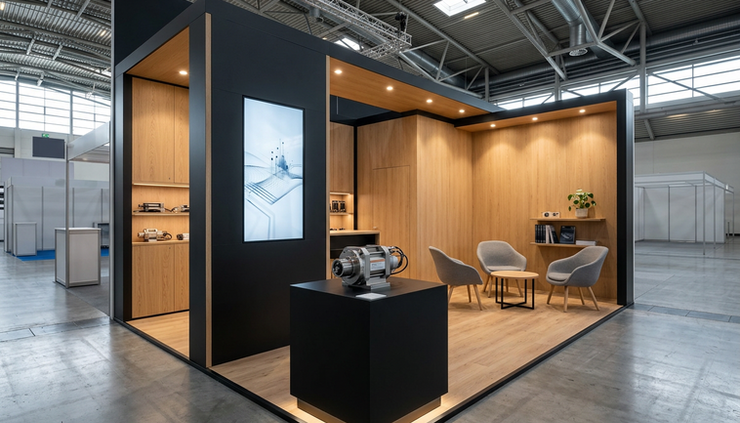
A technology booth at productronica, electronica, and automatica is planned differently than a lifestyle booth. Here, it's not just about visual impact. The exhibit must be stable, clearly explained, and function reliably. productronica and electronica require robust surfaces, power, and a clearly defined explanation zone. automatica also needs space for a demonstration without blocking the aisle. Conversations must still be possible without obstruction. This leads to different priorities regarding space, technology, traffic flow, storage, cable management, and staffing.
A productronica, electronica, or automatica trade fair booth must be designed to be robust. This isn't about adding more decoration. It's about weight, power outlets, sight lines, safety, and clarity. Visitors should quickly understand what the exhibit does. At the same time, the team shouldn't have to spend time explaining things in the aisle.
CA Messebau plans such exhibitions from Duisburg. Their headquarters are located at Moerser Str. 38b, 47228 Duisburg. Assembly takes place at the Munich Trade Fair Center. They do not claim to have an office in Munich. Crucial to their success are meticulous preparation, coordination with the trade fair organizers, service providers, and the team, as well as assembly that fits within the allotted timeframe. CA Messebau can be reached by phone at +49 173 730 78 45.
Why technology booths function differently than lifestyle booths
A lifestyle booth often relies on atmosphere, materials, lighting, and open points of contact. This isn't enough for technical exhibits. A component, a machine, a test setup, or an automation module needs space for explanation. Many visitors come with specific questions. They want to see, touch, compare, or understand how things work.
This results in clear requirements.
The exhibition space must be suitable.
A base for a sample part is different from a cell with movement, sensors, or feeding mechanisms. Even small pieces of technology can require a lot of space when the operating side, maintenance side, and visitor distance are taken into account.
The explanatory area must be located close to the exhibit.
If a monitor, a cutaway model, or a short sequence is positioned too far away, the explanation loses its context. The best solution is often a narrow screen area directly adjacent to the exhibit. It supports the explanation without dominating the space.
The meeting place must be protected.
Technical discussions often take longer than expected. Sketches, samples, data sheets, and questions require quiet. A small seating area in the wrong place disrupts the flow. A slightly screened-off spot behind or to the side of the exhibit area usually works better.
Technology requires a safety margin in its planning.
Electricity, network connections, media connections, air, water, and suspension systems must be clarified early on. Not every exhibition space can support every load or every type of fastening. Permits and structural calculations may also be relevant.
For the regional context, a page on trade fair construction in Munich is helpful if the Munich trade fair grounds are the assembly location but the stand is still planned from outside.
The three trade fairs require different booth layouts.
Productronica, Electronica, and Automatica are all closely related to technology, but their booth design differs. The type of exhibit dictates the approach. An electronics display with samples requires a different layout than an automation demonstration with motion.
Fair | exhibit | Conversation | Technology |
productronica | Machine-proximate samples, manufacturing processes, test setups or components requiring explanation need fixed surfaces and secure positions. | The explanation should begin directly at the exhibit. A quiet spot for further discussion is located to the side or in the rear. | Power points, cable routing, load-bearing capacity and clean media routing should be determined early on. |
electronica | Components, modules, assemblies or interfaces need clear presentation, good lighting and short paths to detailed information. | Discussions often revolve around application, availability, integration, and technical data. For this, a low-interference zone is needed. | Monitors, small exhibit islands, lockers or storage, and precise power planning are often sufficient. |
automatica | Moving demonstrations, grippers, cells or testing procedures require a safe distance and clear view. | The team must be able to explain things without stopping the flow of visitors. Discussions should take place outside the demonstration area. | Space for movement, barriers, emergency stop concept, cable routes and power supply must be planned together. |

A technology stand at Messe München must also comply with the hall's regulations. This includes setup times, delivery routes, connections, the fire behavior of materials, and any necessary permits. These points are not merely decorative; they determine whether the stand can be reliably set up.
This creates a booth layout with exhibit, explanation, and quiet.
The floor plan should not begin with furniture. It begins with the exhibit. This is followed by visitor guidance, explanations, a discussion area, and ancillary spaces.
A practical process looks like this:
Select exhibit
Clarify dimensions, weight, operating side, viewing direction, heat, noise, and movement space. During a demonstration, it's also important to consider where the team will be positioned and where visitors can stand safely.
Determine the main line of sight
The exhibit should be easily visible from the aisle. However, it doesn't need to be placed directly at the edge. For automatica, a slight setback can be useful to keep the aisle clear.
Order declaration
A screen, monitor, sample board, or graphic detail belongs where the team is explaining something. Not just anywhere on the wall. Otherwise, unnecessary steps are taken.
Take conversations out of the flow
Two to four seats can make a big difference, provided they are not located in a passageway. For longer technical discussions, a quiet corner with a good view of the exhibit is often sufficient.
Don't forget the adjacent areas
Storage, brochures, personal belongings, tools, cleaning supplies, and empty bottle collection items do not belong in the visitor area. Even small stands need order behind the scenes.
Stand construction isn't just about walls and counters. It's about a workflow that actually works at the trade fair. A beautiful plan is of little use if the demonstration blocks the aisle or the team has to hunt for the power outlet under the exhibit area.
What should be clarified early on
Technical booths rarely fail because of a single major issue. Often it's small, unresolved issues that ultimately cost time. Therefore, these topics should be addressed early on.
Dimensions and weight
An exhibit with wheels requires different securing methods than a heavy, stationary object. Base height, load distribution, and transport across the area are also important factors.
Electricity and media
How many connections are needed? Where are they located? What power output is required? Will water, compressed air, or internet be needed? These questions are not answered only during the construction phase.
Safety and distance
Moving parts, hot surfaces, sharp edges, or loud noises require a clear concept. This is especially true for demonstrations at automatica.
Explanation and content
A monitor can effectively display technical content if the message is clear. Short sequences, cuts, process steps, and detailed graphics are more helpful than long videos.
Logistics and assembly
Delivery, packaging, tools, lifting equipment, setup time and acceptance must all be tailored to the trade fair. Those who only plan the visible stand are planning too late.
A well-structured project management system for trade fair construction keeps these points together, from planning to assembly at the Munich trade fair grounds.

An LED screen isn't automatically the right solution. It can be useful when large content needs to be legible from a distance or when a demonstration needs to be visually accompanied. For many technical applications, a good monitor or a narrow screen is sufficient. Those interested in exploring a larger LED solution can find details about renting an LED video wall . It remains an optional module, not a standard feature for every booth.
What a fixed price means and what it doesn't
A fixed price can provide planning security. However, it only applies to the agreed-upon scope. This is important. The scope must be clearly defined. This includes, for example, stand construction, defined materials, furniture, assembly services, transport costs, and planned media areas, if agreed upon.
Costs incurred through the trade fair, the organizer, or external service providers are not automatically included. These include:
Stand rental
Electricity
Water
Internet
permit
Statics
These points can be relevant depending on the trade fair, the exhibition space, and the exhibit. Therefore, a detailed breakdown should be included in the offer. This way, you can clearly see what the fixed price covers and which items will be commissioned or billed separately.
3D images aid in planning. They show proportions, pathways, material effects, and the position of exhibits and screens. They are planning concepts, not built references. This should be clearly stated. A good 3D concept does not replace technical review. However, it makes it clear early on whether explanations, discussions, and demonstrations will work well together in the space.
How CA Messebau is approaching the planning for Munich
CA Messebau is located in Duisburg, Moerser Str. 38b, 47228 Duisburg. Planning can be carried out from there. Assembly takes place at the Munich Trade Fair Center. This requires thorough preparation: dimensions, data, trade fair specifications, setup time, delivery window, and responsibilities.
The process is kept simple.
Briefing
They provide information on the target location, trade fair, floor space, exhibit data, and desired use. The more precise the dimensions, weight, and technical requirements, the faster the stand can be planned.
concept
The layout organizes the exhibit, explanation, discussion area, and ancillary spaces. 3D images visualize the solution. They remain concepts for planning purposes.
vote
Open issues such as electricity, water, internet, permits, or structural engineering will be considered separately. Anything not explicitly included in the agreed scope will not be tacitly considered included.
Assembly in Munich
The team is setting up the booth at the Munich trade fair. Clear documentation, consistent scheduling, and easily accessible contacts are crucial.
For questions or to determine the next step, please use the contact form or call +49 173 730 78 45.
FAQ
What area is suitable for a technical exhibit?
The required space depends on the exhibit's dimensions, the operating side, safety distances, and the explanation zone. A small model can function in just a few square meters. A dynamic demonstration needs significantly more open space to prevent visitors from standing in the aisle. Dimensions, weight, power requirements, and movement space are all important factors.
Row stand or corner stand.
A single booth in a row may suffice if the exhibit is clearly oriented towards the aisle and conversations take place to the side or rear. A corner booth offers two open sides. This is helpful for exhibits requiring explanation and for demonstrations, as it allows visitors to spread out more easily. The decision depends on the flow of visitors and the line of sight, not just on the size.
When is a monitor sufficient instead of an LED wall?
A monitor is often sufficient when content needs to be explained from a short distance. This applies to detailed graphics, process steps, cutaway views, or short sequences. An LED wall is more useful when content needs to be visible from a greater distance. It is an optional module and should only be included in the plan if it truly enhances the booth.
What is not included in the fixed price?
A fixed price applies only to the agreed-upon scope. Stand rental, electricity, water, internet, permits, and structural engineering are extra unless explicitly included in the offer. These costs are often handled by the trade fair, organizer, or trade fair service provider.
Is CA planning to build exhibition stands from Duisburg for Munich?
Yes. CA Messebau is based in Duisburg, Moerser Str. 38b, 47228 Duisburg. Planning can be done from there. Assembly takes place at the Munich Trade Fair Center. They do not claim to have an office in Munich.
The next step
A technology booth for productronica, electronica, or automatica requires a clear plan. Exhibit, explanation, discussion, and technology must all fit together. First, define the exhibit. Then, create the floor plan, media areas, connections, and assembly plan.


Comments