
Planning an exhibition stand made easy: The complete guide for exhibitors

A trade fair booth can quickly become expensive if decisions are made too late or important requirements only become apparent during setup. Good planning protects your budget, reduces friction in the project, and ensures that your company remains clearly recognizable at the trade fair.
Thorough preparation for a trade fair appearance involves more than just deciding on walls, lighting, and furniture. It's about objectives, visitor flow, conversations, exhibits, technology, storage space, staff traffic flow, and a stand that aligns with the brand. This guide leads you step-by-step through the most important phases, from setting initial goals to handover at the exhibition grounds.

1. Define goals and KPIs before designing.
Before discussing colors, materials, or booth designs, it should be clear what the trade fair appearance is intended to achieve. The design follows the objectives, not the other way around.
Typical destinations for exhibitors include:
Gaining new contacts
For example, qualified leads from specific industries or regions.
Maintain existing customers
The booth then needs quiet areas for conversation, good scheduling, and clear reception processes.
Show products live
For this, demonstration areas, electricity, safety, ground loads and sight lines are important.
Strengthen brand presence
The booth must be recognizable from a distance and fit your company's positioning.
Accelerating sales conversations
Product zones, media areas and short distances for the booth team will then be helpful.
To do this, define measurable criteria. These don't have to be complicated key performance indicators. For example, the following are useful:
Number of qualified conversations
Number of agreed follow-up appointments
Number of product demos per trade fair day
Percentage of visitors from target industries
Feedback from the booth team on visitor flow and conversation quality
Budget adherence in the project
When planning an exhibition stand , these goals form the basis for all subsequent decisions. An open communication stand requires a different architecture than a consultation stand for confidential discussions.
2. Choose the appropriate trade fair, stand size and standard
The best design is of little use if the trade fair, booth size, or booth type doesn't suit the target group. Therefore, check early on which event promises the greatest benefit.
Questions like the following provide good guidance:
Is the trade fair a good fit for your target industries?
Are decision-makers or more likely to be trade visitors present?
Is it about acquiring new customers, image, recruiting, or product launch?
Which hall location is realistically available?
Which competitors are exhibiting there?
What booth size is needed for your exhibits and communication goals?
You can find an initial overview of relevant events in CA Messebau's trade fair overview . This is particularly helpful if several exhibition venues or industry events are being considered.
Correctly assessing stance types
The standard influences visibility, visitor flow, and costs. Common forms include:
Stand type | Suitable for | What you should pay attention to |
Lineup | smaller spaces, clear products, limited budget | Strong visual impact, clear invitation to enter. |
Corner stand | Increased visibility from two sides | Plan visitor flow from both entrances |
Headstand | very open, good long-range impact | clear zoning so that the stand doesn't appear arbitrary. |
Island stand | large brand appearances, large visitor flows | Extensive planning is required for paths, ceilings, technology and personnel. |
Choose between custom construction, modular construction or mixed construction
The construction method should also be suitable for the intended purpose.
Custom-built homes are suitable if you require a unique spatial effect, special materials, or complex product presentations. They appear high-quality and flexible, but require more planning.
Modular construction makes sense when budget, rapid implementation, and reusability are paramount. Modern systems can have a very clean and brand-appropriate appearance.
Hybrid construction combines both. System elements create structure and efficiency, while individual components add distinctive touches. For many exhibitors, this is a good approach if the stand is to appear professional without becoming unnecessarily complex.

3. Create a complete briefing
A good briefing saves time, prevents misunderstandings, and makes offers comparable. It doesn't have to be perfectly worded, but it should be complete enough for the exhibition stand builder to understand the task.
Content for your trade fair briefing
Use these points as a basis:
Brand and positioning
What values should be highlighted? Should the booth appear objective, technical, high-quality, approachable, or particularly open?
Products and exhibits
What products are shown? Are there any weights, dimensions, safety requirements, or connection details?
Visitor flow
How should people enter the booth, orient themselves, and leave? Which areas should be immediately visible?
Discussions and meetings
Do you need standing tables, seating areas, enclosed rooms or semi-protected consultation areas?
Storage and ancillary areas
Plan space for brochures, samples, personal items, packaging, coffee machine, refrigerator or cleaning supplies.
Media and Technology
What screens, presentation surfaces, devices, sound sources, power connections or networks are needed?
Personnel and processes
How many people are working at the booth at the same time? Is there a reception area, consultation service, demonstration area, service, or catering?
Budget and priorities
State a realistic framework and highlight what is essential.
A clear trade fair stand checklist in the briefing prevents important points from only emerging during the trade fair preparation.
4. Develop a design and 3D visualization
Once the objectives, space requirements, and briefing are defined, the design phase begins. Now, requirements are transformed into a tangible concept. This isn't just about aesthetics. A good booth design answers practical questions:
Is your company recognizable from the main axis of the building?
Is the entrance clear?
Is there a logical sequence for products, consultation, and closing discussions?
Are the walkways clear?
Do employees have enough storage space and places to retreat to?
Do light, media, and signage work together?
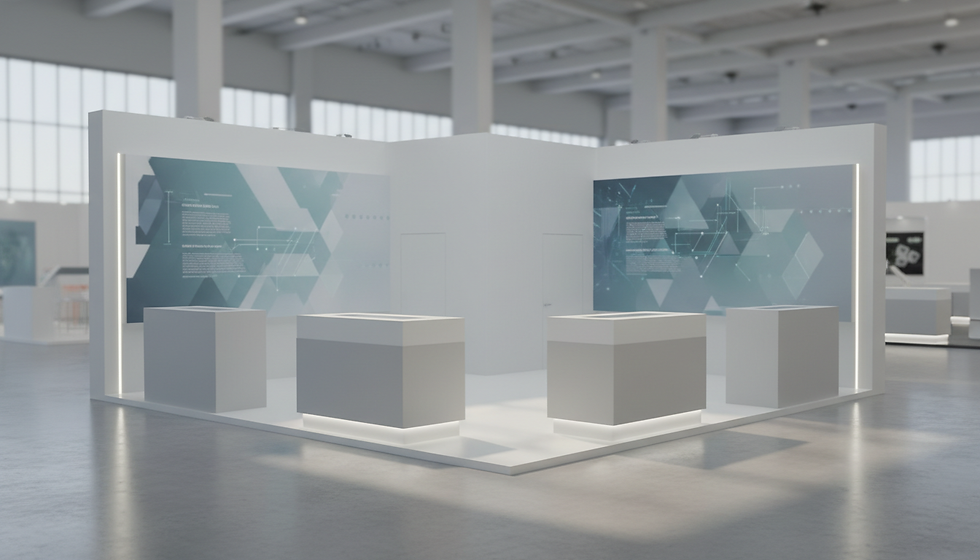
CA Messebau offers exhibitors a free 3D design and a fixed-price quote . This is particularly helpful because you can visualize the planned exhibition stand in three dimensions beforehand. This allows you to assess proportions, sight lines, furniture, graphics, and product areas more effectively than with a flat sketch.
More information about visualization can be found under free 3D design from CA Messebau .
What you should pay attention to when designing in 3D
Don't just evaluate the design based on personal taste. Review it from the perspective of different visitors:
What do I see as I walk by?
Where can I immediately identify the main offer?
Where do I stop?
Where does a conversation begin?
Where can the booth team discreetly retrieve documents or samples?
Does the stall still look tidy even when there are many people there?
Give feedback early and specifically. Statements like "we need more visibility on the open page" are more helpful than general comments.
5. Plan the timeline from 12 months until the start of the trade fair.
The larger and more customized the stand, the earlier the planning should begin. Even smaller exhibition stands benefit from a clear schedule, because hall bookings, permits, graphic data, and logistics all have fixed deadlines.
time | Important tasks |
12 to 9 months in advance | Select a trade fair, define goals, determine budget, request or book exhibition space |
9 to 6 months in advance | Clarify stand type, create briefing, involve stand builders, review initial concepts |
6 to 4 months in advance | Coordinate 3D design, compare offers, determine materials and features |
4 to 3 months in advance | Finalizing technology, graphics, exhibits, furniture, media and services |
3 to 2 months in advance | Provide print data, check approvals, plan transport and assembly |
2 to 1 month in advance | Brief booth staff, create discussion guides, schedule appointments, check checklists |
2 weeks prior | Check the latest data, prepare samples, brochures and equipment |
Trade fair week | Accompany setup, conduct stand inspection, brief the team |
Trade fair start | Test functions, check order, start visitor engagement |
In very short-term projects, all is not lost. However, it is crucial to quickly set priorities and choose only solutions that are reliably implementable.

6. Manage project management, logistics, setup and handover
A trade fair stand is made up of many individual parts. Design, structural engineering, graphics, electrical work, flooring, furniture, transport, assembly, hall specifications, and deadlines must all fit together. This is precisely where the value of meticulous project management becomes apparent.
CA Messebau, a full-service exhibition stand builder based in Duisburg, operates nationwide and supports exhibitors from the initial concept to handover at the exhibition grounds. Centralized project management helps to reduce interfaces and ensure clear documentation of decisions.
Professional implementation includes:
Coordination with trade fair organizers and hall service providers
Review of technical guidelines
Coordination of graphics, construction, electricity, lighting and media
Scheduling for manufacturing, transport and assembly
Monitoring of implementation on site
Handover of the completed stand to the stand team
Clarification of dismantling and storage, if desired.
You can find more information on the page about project management in trade fair construction .
Don't underestimate the handover of the stand.
The handover is more than just a quick tour. Check on site:
Are all the graphics correctly positioned?
Do the lights, screens, and ports work?
Are the furniture, exhibits, and storage areas complete?
Are there any visible damages?
Have the keys, remote controls and technical instructions been handed over?
Does the booth team know the most important functions?
Allow sufficient time for this check. Minor corrections can usually be made more easily before the trade fair begins than during the initial influx of visitors.
7. Avoid typical planning mistakes
Many problems arise not from bad ideas, but from a lack of coordination. These errors occur particularly frequently.
The design process begins without a clear goal.
A beautiful booth is not automatically an effective one. Without a defined objective, the result is often a space that looks good but doesn't support conversations, demonstrations, or visitor flow.
The budget will be finalized too late.
If no budget is specified, designs are created that later have to be significantly reduced. This wastes time and often leads to compromises in the wrong places.
Storage space is forgotten
Brochures, bags, jackets, packaging, drinks, and cleaning supplies all need space. Without sufficient storage, the booth quickly appears cluttered.
Visitor routes are not planned
An open booth can be inviting. But it can also lead to people just passing through. Plan clear focal points.
Graphics data arrives too late
Print data, sizes, bleed, resolution, and approvals should be included in the schedule early on. Late graphic changes can increase costs and stress.
Technology is considered in isolation
Monitors, lighting, sound, power, and internet must fit into the booth architecture. Cables, connections, and operation should not be determined only during setup.
The booth team will not be involved.
The people at the booth often know exactly which conversations, samples, and processes are important. Involve sales, marketing, and product managers early in the planning process for your trade fair appearance.
8. Use the final checklist before the trade fair.
Shortly before the event, a concise list helps to ensure that nothing essential remains unfinished.

Check these points before assembly:
Goals, KPIs and target groups are agreed upon internally.
Stand area, stand type and hall location have been confirmed.
The briefing, budget, and priorities are available in writing.
3D design, materials, furniture and equipment have been approved.
Exhibits, product samples and technical requirements have been clarified.
Graphic data has been finalized and delivered on time.
Electricity, light, media, internet and other services have been ordered.
Transport, setup times and local contact persons are known.
Booth staff, shifts, and conversation procedures are planned.
10. Storage space, cleaning, catering and consumables are included.
11. Handover, functional testing and acceptance are scheduled.
12. Dismantling, return transport or storage are organized.
9. Take the next step with a clear concept.
A successful trade fair booth isn't created through isolated decisions, but rather through a seamless sequence of objectives, briefing, design, planning, and implementation. When these steps are aligned, you keep costs under better control and create a trade fair space that clearly showcases your brand and facilitates conversations.
CA Messebau, based in Duisburg, supports exhibitors as a full-service partner, handling concept development, planning, project management, construction, logistics, and handover. If you are preparing a specific project, you can request a free 3D concept with a fixed-price quote or learn more about our free 3D design service .
This is how an idea becomes a plannable trade fair appearance that fits the budget, the space and your goals.


Comments