
Measuring trade fair booth success: KPIs, lead processes and ROI for exhibitors
A trade fair booth is not an end in itself. Space, construction, technology, personnel, travel, logistics, and follow-up only result in a sound investment if it's clear beforehand how success will be measured. Without measurable goals, what often remains after the fair is a gut feeling: "It was busy" or "The conversations went well." That's not enough for budget decisions.
Measuring trade fair success doesn't require a complicated data architecture. What's crucial are clear goals, a few relevant KPIs, a streamlined lead generation process at the booth, and rapid follow-up. This allows for a significantly better assessment of the trade fair ROI, even if not every sale is finalized directly at the fair.
This guide shows step by step how exhibitors can plan, record and evaluate their trade fair stand success.

1. Set specific goals before the trade fair.
The most important question comes before the stand planning: What should the trade fair appearance achieve?
Many exhibitors start with space, design, and exhibits. The reverse approach is better: first define your goals, then develop your booth concept. A booth for acquiring new customers requires different space, signals, and processes than a booth for product demonstrations or meetings with existing customers.
Typical trade fair destinations include:
Gain leads
New contacts with genuine interest, segmented by quality and need.
appointments
Planned meetings with customers, partners, or potential clients.
Conducting demonstrations
Product demonstrations, live tests, or presentations with extensive explanations.
Make the brand visible
Recognition, frequency at the booth, dwell time and conversation starters.
Support pipeline
Accelerate existing sales opportunities, address objections, and reach decision-makers.
A good goal is specific enough to derive actionable steps. "Increased visibility" remains too vague. Better: "We want to reach decision-makers from three target industries and document at least 80 qualified conversations." This isn't a guarantee of revenue, but it's a clear metric.
2. Translate goals into the right KPIs.
Not every metric is useful. A high number of visitors to a booth sounds good, but says little about business potential. A single qualified appointment with a budget and a clear need can be more valuable than 30 quick scans without context.
A meaningful set of KPIs combines activity, quality, and results.
Goal | Possible KPIs | Why these key figures help |
Gaining new contacts | Number of leads captured, percentage of qualified leads, origin of contacts | It shows whether the booth reaches the right target group. |
Improving conversations | Conversation duration, conversation quality, next steps | It separates fleeting contacts from real opportunities. |
Demos increase | Number of demonstrations, demonstration cancellations, follow-up discussions after demonstrations | Shows whether the product and stand setup work. |
Promote pipeline | Appointments after the trade fair, offers, sales opportunities | Combines trade fair activity with sales results |
Assess brand impact | Frequency of visits, duration of stay, interactions with exhibits | Helps in assessing visibility and appeal |
A good trade fair booth KPI is not only measurable, but also controllable. If the number is poor, it should be clear what can be changed: approach, booth positioning, exhibits, staffing, visitor flow, or follow-up.
3. Define lead quality, not just lead quantity.
Many trade fair reports start by citing the number of contacts collected. This figure is readily available, but often misleading. For measuring success, it's not just about how many trade fair leads are in the system, but how well they align with the sales target.
A simple lead classification is usually sufficient:
category | Meaning | Typical next step |
A-Lead | Specific need, suitable target group, timely decision possible | Personal contact within 24 to 48 hours |
B-Lead | Interest exists, but the need is not yet fully clear. | Qualifying email and appointment offer |
C-Lead | General interest, no clear intention to buy. | Nurturing, newsletters, or later contact |
Contact without potential | Not a fitness activity or purely informational. | No active sales priority |
It's important that these categories are defined before the trade fair. The booth team needs to know which questions to ask. Otherwise, leads will be evaluated later based on intuition.
Helpful qualification questions include, for example:
What challenge needs to be solved?
Within what timeframe is a decision planned?
Who is involved in the decision-making process?
Is there already a budget or a specific reason for the project?
Which solution is currently in use?
This is how a contact becomes a usable data set. This is precisely where measurable trade fair ROI begins.
4. Integrate the lead process directly into booth operations.
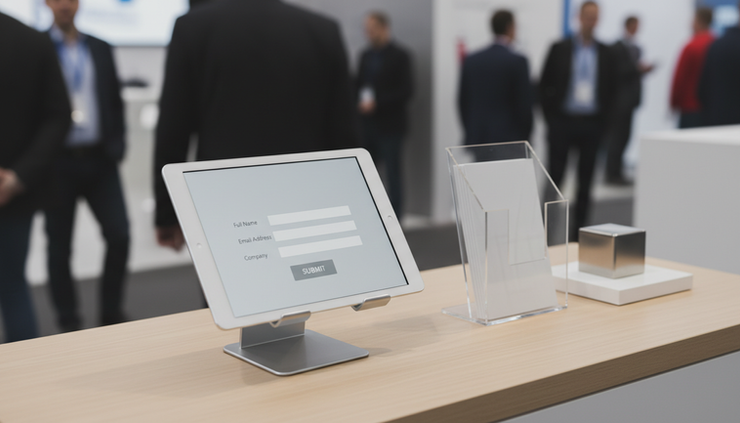
Lead capture shouldn't be an afterthought. It's as integral to the booth concept as lighting, counter, and exhibits. If conversations are only reconstructed from business cards after the trade fair has ended, details are lost.
A practical process comprises four points.
Capture contacts instantly
Use a digital form, a trade fair app, or a CRM-compatible tool. It's important to include only required fields that are truly necessary. Too many fields slow down the conversation. Too few fields render the lead worthless later on.
Relevant fields include:
Name and company
role or function
Contact details with consent
Area of interest
Lead Category
Need or project reason
agreed next step
responsible person in sales
Document the context of the conversation.
The statement "interested in product A" is rarely sufficient. A short note is better: "Looking for a solution for a new production line, decision expected in the second half of the year, would like technical details and price range." This kind of information makes all the difference in follow-up.
Train the booth team
All participants should use the same criteria. Otherwise, one person might classify almost every contact as an A-lead, while another person is very strict in their sorting. A brief briefing before the trade fair begins will prevent data problems later on.
Plan handovers during the trade fair
Particularly valuable contacts shouldn't wait until after the trade fair to be followed up. If an A-lead is generated in the morning, the responsible sales representative can react on the same day or schedule a follow-up appointment.
5. Schedule the follow-up within 48 hours.
The trade fair doesn't end with the dismantling of the booths. For many exhibitors, the crucial part only begins afterward. The faster and more appropriate the follow-up, the better the interest generated can be translated into concrete next steps.
The 48-hour rule isn't a magic number, but it's a good standard. After two days, conversations are still fresh in people's minds. After two weeks, the trade fair contact is often just one of many.
A good follow-up process differentiates based on lead quality:
Lead type | timing | Contents |
A-Lead | Within 24 to 48 hours | Personal message, reference to conversation, appointment suggestion |
B-Lead | Within 48 hours | Relevant documents, clarifying question, offer for discussion |
C-Lead | Within a few days | Thanks, relevant content, subsequent contact |
Existing customer | Individual arrangements can be made by agreement | Summary, open questions, next appointment |
Personal relevance is key. A generic thank-you email to all contacts misses the mark. A short message relating to the specific trade fair topic is much better.
Example:
"Thank you for the discussion regarding your planned expansion of the production area. Enclosed you will find the technical documents discussed. We would be happy to suggest a 30-minute meeting next week to examine the requirements in more detail."
This way, the contact immediately recognizes that the conversation has been understood.
6. Calculate the trade fair ROI in a transparent way.
The full ROI of a trade fair is rarely visible on the day after the event. Many purchasing decisions take weeks or months. Nevertheless, a sound evaluation logic can be established.
Start with the total costs:
Floor space
Stand construction
Technology
Transport and logistics
staff
Travel and accommodation
Marketing material
Catering
Follow-up
Then you assign results to:
qualified leads
guided appointments
planned follow-up appointments
Offers
new sales opportunities
won orders as soon as they arise
A simple formula for later consideration is:
`Trade fair ROI = attributable revenue from trade fair contacts ÷ total costs of the trade fair appearance`
This formula is only useful if the mapping is properly maintained. Every lead needs a source, for example, "Trade Fair 2026". Offers and sales should remain linked to this source in the CRM. This creates a realistic picture over time.
Interim indicators are helpful for early evaluation:
Cost per qualified lead
Cost per A-lead
Cost per follow-up appointment
Offer rate from trade fair leads
Conversion rate from trade fair contacts over a defined period
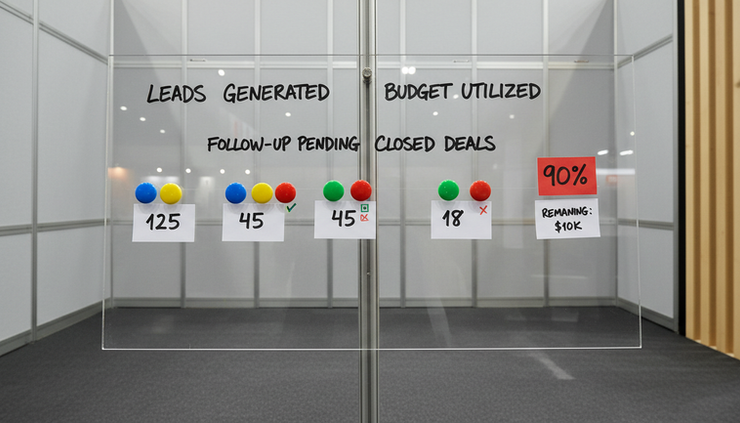
None of these figures tells the whole story on its own. Together, they show whether the trade fair appearance was economically worthwhile and where improvements are possible.
7. Combine stand design with measurable results
Design isn't just about visual appeal. It influences how many people enter the booth, how long they stay, and whether conversations start. That's why design belongs in the ROI analysis.
Visitor flow directs conversation opportunities
An open booth with clear pathways lowers the barrier to entry. Visitors quickly see where to enter, what is on display, and whom they can approach. Narrow passages, unclear zones, or obscured exhibits hinder interaction.
Therefore, plan your booth according to typical visitor routes:
Where do visitors first pass by?
What do they see in the first three meters?
Is there a clear point of contact?
Are the demonstration areas easily accessible?
Are there quiet areas for meaningful conversations?
LED surfaces can measurably increase attention
LED walls and illuminated elements are not an end in themselves. They should explain messages, provide orientation, or highlight product benefits. Short content, clear visuals, and movements that don't appear cluttered are particularly effective.
The effect becomes measurable when the stand team observes and documents:
What content triggers conversation starters?
At what times does the frequency increase?
Which exhibits or media will keep visitors at the booth longer?
What message is repeated in the conversation?
In this way, light and moving images become part of the success measurement, not just a design element.
Project management protects the result
A trade fair booth can be strategically well-planned and still suffer from poor execution. Delays, unclear responsibilities, or last-minute changes cost time and cause frustration. Poor project management indirectly impacts KPIs, for example, through reduced testing time, missing briefings, or improvised booth processes.
Good project management ensures that design, technology, setup, approvals, and personnel planning are all aligned. This doesn't automatically improve every key performance indicator, but it creates the foundation for smooth trade fair operations.
8. Make the budget and scope of services transparent
ROI planning requires reliable costs. If the scope of work is constantly changing or important items only become apparent late in the process, the profitability calculation becomes inaccurate.
A fixed price with a clearly defined scope of services helps to estimate trade fair costs in advance. This doesn't mean that every project is the same. It means that exhibitors know which services are included and which additional services can be arranged separately.
The following are particularly important for planning:
clear description of stand construction and equipment
defined technical services
Transparent information on transport, assembly and disassembly
Timely clarification of special requests
comprehensible distinction between standard and additional services
This allows for an assessment, even before the trade fair, of the results needed to make the appearance economically viable. Budget transparency prevents the subsequent ROI evaluation from becoming a guessing game.
9. Evaluate and improve your next performance
The evaluation should take place promptly after the trade fair, ideally while impressions are fresh and all data is available.
A meaningful review comprises three levels:
Pay
Which KPIs were achieved? Where were there deviations? What was the lead quality?
Processes
Did the data collection process work? Were the criteria clear? Was the follow-up timely?
Stability
Which areas were heavily used? Where did conversations take place? Which elements fell short of expectations?
The goal is not to assign blame. It's about identifying lessons learned for the next trade fair appearance. Perhaps the demo area was too small. Perhaps too many contacts were unqualified. Perhaps the LED display worked well, but the follow-up processes were too slow.
These insights will make the next trade fair even stronger.

FAQ on trade fair stand success
Which KPIs are most important for exhibitors?
The most important KPIs depend on the goal. Often useful metrics include qualified leads, A-leads, follow-up appointments, quotes, cost per qualified lead, and subsequent orders won from trade fair contacts.
How quickly should the follow-up take place after the trade fair?
For high-quality leads, contact should be made within 24 to 48 hours. The more specific the interest, the more personal and faster the follow-up should be.
How can brand impact be measured?
Brand impact is harder to directly assess than leads. Useful metrics include booth frequency, dwell time, interactions with exhibits, recurring conversation starters, and qualitative feedback from the booth team.
What should be included in a good lead form?
A good form includes contact details, consent, area of interest, lead category, needs, time horizon, conversation notes, and next step. It should be short enough to be used quickly at the booth.
Why does booth construction affect ROI?
Booth design influences visibility, visitor flow, conversation quality, and the demo experience. A well-planned booth can help the team have more relevant conversations and capture leads more effectively.
The next step towards measurable trade fair success
A successful trade fair appearance doesn't just happen on the exhibition floor. It arises from clear goals, relevant KPIs, a simple lead process, rapid follow-up, and a stand that supports visitor guidance, technology, and conversation quality.
CA Messebau supports exhibitors from planning to implementation. If you would like to plan your next exhibition stand with a transparent budget and a clear scope of services, you can request a quote here: Request an exhibition stand quote from CA Messebau .
If you would like to learn more about how professional management ensures a smooth process, you can find further information on project management in exhibition stand construction here.


Comments