
First-time exhibitors at the 2026 trade fair: Guide for your first appearance

The first trade fair appearance often seems bigger than it actually is. Hall layout, stand size, construction, budget, logistics, personnel, design, technology, acceptance, follow-up. Everything is interconnected, and many things have deadlines.
The good news: A professional trade fair appearance becomes manageable when you break it down into clear decisions. This guide takes you step by step through the most important points for 2026, especially for medium-sized B2B companies exhibiting in Germany for the first time.
CA Messebau supports first-time exhibitors with full-service solutions from Duisburg, available throughout Germany. The goal is not to occupy as much space as possible. The goal is an exhibition stand that suits your objectives, your budget, and your team.
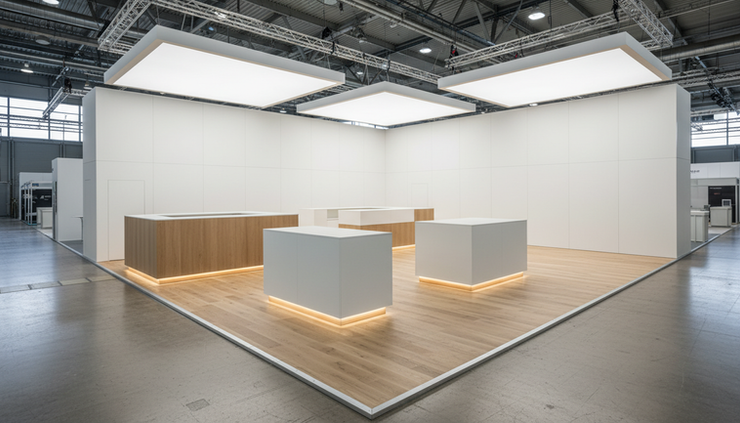
1. First, sort out the overwhelming situation - first-time exhibitors at a trade fair
Many teams search for "first-time exhibitor trade fair" because they need a starting point. That makes perfect sense. Those who start without a structure quickly lose time on details.
Typical questions at the beginning are:
Which trade fair is right for our market?
How big does the stall need to be?
Is a standard system sufficient, or do we need a custom-built solution?
What does a first trade fair booth really cost?
When do we need to decide?
Who takes care of setup, technology and acceptance?
How can we avoid surprises shortly before the trade fair starts?
These questions are normal. They don't indicate that your project is too complicated. They simply show that a trade fair brings together many different trades.
A good starting point consists of three simple work packages:
Clarify the goal and role of the trade fair appearance
Roughly define the floor area, budget, and construction method.
Prepare briefing for the exhibition stand builder
This shifts the focus from "We have to think of everything" to "We decide one thing at a time." This order is particularly important for beginners.
If you plan your stand construction with an experienced partner , you will get a more realistic picture early on of what is possible on your space and which decisions could become expensive later.
2. Define what your trade fair appearance should achieve.
Before you talk about walls, counters, or flooring, you need goals. Without a goal, the booth quickly becomes a collection of good individual ideas. With a goal, it becomes a sales and communication space.
In B2B, the following goals are often relevant:
Gain new contacts
Meet existing customers in person
explain new products or services
Preparing for sales meetings
Invite dealers, partners or suppliers
Increase visibility in a specific market segment
Building trust in services that require explanation
Not every goal requires the same setup. A company that anticipates many brief initial contacts needs open pathways, quick orientation, and a clearly defined conversation zone. A company with confidential project discussions, on the other hand, is more likely to need a closed or semi-closed meeting room.
Ask internally early:
What should be different after the trade fair compared to before?
Which target groups are realistically expected to visit the booth?
Which conversations have priority?
What message must be recognizable within a few seconds?
What exhibits, samples, or demonstrations should be shown?
What tasks does the booth staff perform?
Especially for first-time exhibitors, less is often more when it comes to trade fair appearances. One clear main message beats five equally prominent topics. Visitors only notice a booth in passing. They quickly decide whether the booth seems relevant.
A trade fair booth is not a showroom for everything a company can do. It is a place for the most important conversations.
3. Plan the overall budget realistically
Many first-time exhibitors focus primarily on the cost of stand construction. This is understandable, but incomplete. The trade fair budget consists of several components. If you only calculate the visible structure, you'll miss important items later.
The total budget usually includes:
Cost area | Typical contents |
Floor space | Rental space at the organizer's premises, additional costs, exhibitor packages |
Stand construction | Construction, walls, ceiling, graphic surfaces, floor, furniture |
design | 3D design, layout, visitor guidance, design coordination |
Technology | Electricity, light, connections, monitors, and, if necessary, water or compressed air. |
logistics | Transport, storage, loading and unloading, packaging |
On-site service | Setup, dismantling, stand inspection, technical clarifications |
staff | Travel, hotel, meals, training, clothing if desired |
marketing | Invitations, documents, samples, lead capture, follow-up actions |
This list is not meant to discourage you. It helps you ask the right questions early on. A fixed price for stand construction reduces uncertainty, but it doesn't replace a complete budget plan for the entire trade fair appearance.
CA Messebau therefore works with risk reducers that are particularly helpful in the first project:
Free 3D design so you can see the stand in advance and coordinate internally.
Fixed price guarantee , so that the agreed scope of services remains predictable.
Project management to ensure coordination of voting, deadlines, and trades.
This is particularly helpful if you don't have your own in-house exhibition stand construction team. Marketing, sales, and management can then make decisions without having to manage every technical detail themselves.
4. Choose a booth size that is suitable for conversations and exhibits.
The ideal booth size isn't just a matter of budget. It's determined by its intended use. A small, well-structured booth can be more effective than a larger space with unclear layout.
Plan the size based on these questions:
How many people should work at the stand at the same time?
How many visitors are you expecting at one time?
Are there any exhibits, machines, samples, or displays?
Do you need seating for consultations?
Is storage space needed for bags, brochures, drinks, or packaging?
Should a meeting room be integrated?
Is an open, semi-open, or closed stand design appropriate?
Typical stance forms are:
Standing form | Suitable for |
Lineup | clear front, often efficient in limited space |
Corner stand | two open sides, good visibility on walkways |
Headstand | Three open pages, good for high visitor traffic |
Island stand | four open sides, strong with high visibility and clear brand management |
For a successful first booth, the biggest one isn't necessarily the best choice. What's crucial is that visitors can easily understand the booth. Where is the reception area? Where can people talk to each other? Where are there demonstrations? Where does the team stand without blocking walkways?
A simple practical test: Draw the sequence of a typical visitor. A person walks by, stops, is approached, sees an exhibit, has a conversation, leaves their contact details, and moves on. If this path works logically on the floor plan, you're closer to a good booth size.
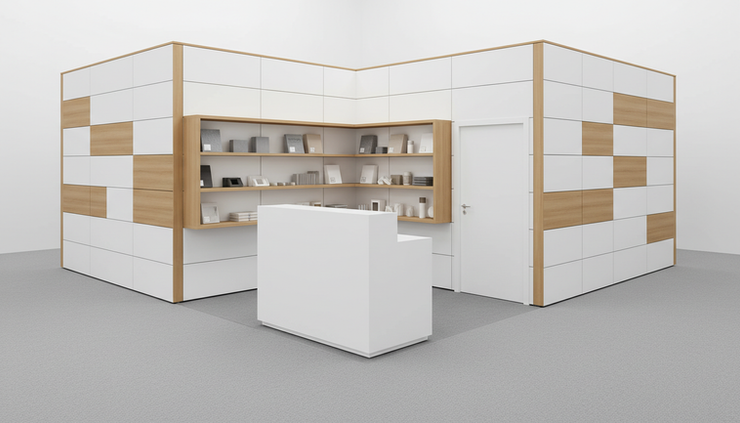
5. Decide on the construction method based on purpose, budget and reuse.
First-time exhibitors often face the question: system construction, hybrid construction, or custom construction? The answer depends on how eye-catching the stand needs to be, how much explanation your offering requires, and whether you plan to reuse components later.
Start with system construction when clarity and predictability are important.
System construction utilizes proven components and standardized designs. This helps with costs, setup time, and planning. For many first-time B2B exhibitors, this is a good starting point because the stand appears professional yet remains efficient.
Modular construction is particularly suitable if:
exhibiting them for the first time
The status should remain clear.
the budget is clearly limited
You need a simple, clean presentation
no special form is necessary
Use hybrid construction if you need more independence.
Hybrid construction combines system elements with more individual components. This could be a special back wall, a separate reception area, a striking product zone, or a high-quality meeting area.
This option is often useful if you want planning certainty, but don't want the stand to appear too generic. Small and medium-sized enterprises (SMEs) in particular often find this a good middle ground.
Choose custom build when differentiation is crucial.
Custom building is worthwhile when the brand, architecture, or product presentation plays a special role. This can be the case with a market launch, a highly competitive market, or a technical solution that requires explanation.
Custom-built homes offer more design freedom but require more planning. If differentiation is critical, they can be the right choice. If the goal is more about initial presence, establishing contacts, and providing orientation, a well-designed modular or hybrid building is often sufficient.
An overview of design issues can be found in the section on trade fair stand design . There you will see how design, visitor guidance and function are interconnected.
6. Work with a timeline, not just a deadline.
The trade fair date is set. But that doesn't mean everything can wait until the last minute. Good trade fair planning starts backwards from the first day of setup.
A realistic scenario often looks like this:
phase | What happens |
orientation | Clarify objectives, trade fair, space, rough budget and internal responsibilities |
Briefing | Gather information on floor plan, requirements, exhibits, rooms, materials and technical specifications. |
Draft | Review 3D design, provide feedback, obtain internal approvals |
Offer | Agree on the scope of services, fixed price, deadlines and responsibilities |
Detailed planning | Define graphics, electricity, lighting, furniture, flooring, storage, and meeting area |
production | Prepare components, graphics and materials |
Construction | Delivery, assembly, technical inspection and handover of the stand |
Trade fair operations | Conducting conversations, capturing leads, keeping the office tidy |
dismantling | Dismantling, packaging, clarification of storage or disposal |
Follow-up | Evaluate contacts, follow up, assess results |
The earlier you start with the briefing, the better. Late changes are usually more difficult because orders, production, and warehouse logistics are already underway. This is especially true for special requests, large graphics, technical connections, or two-story booth concepts.
If you're working internally with multiple stakeholders, designate a decision-making contact person. This person gathers feedback, prioritizes requests, and grants approvals. This reduces repetitive processes and protects the schedule.
7. Prepare a briefing that speeds up decision-making.
Your briefing doesn't need to be perfect. It just needs to be usable. A good exhibition stand builder will ask follow-up questions. The better your information, the faster a suitable design will be created.
The following information is particularly important for a quote request:
Mass and date
Stand layout or stand form
Stand size in square meters
desired material or material effect
Request for a two-story stand
Need for a meeting room
Storage space requirements
desired floor
Exhibits, samples or displays
Technical requirements, for example electricity, light or media surfaces
Number of people at the stand
desired effect of the stand
CA Messebau specifically asks about these points during the quotation process. This helps ensure that the stand isn't planned blindly. If you already have a hall plan or stand number, please include that as well.
Describe not only what you want, but also why.
Instead of "We need a counter," it's more helpful to say: "We need a clearly identifiable reception area for initial contacts and documents." Instead of "We would like a meeting room," write: "We conduct confidential project meetings with two to four people."
The difference is significant. The exhibition stand builder can then suggest solutions that suit the intended use. Perhaps a semi-open meeting area will suffice. Perhaps an enclosed room would be more suitable. Perhaps a counter in the wrong location would disrupt the flow of visitors.
Gather internal material early
The design process usually requires content:
Logos and design guidelines
Colors and fonts, if any
Images in print-ready quality
Product data or technical drawings
short messages for wall surfaces
Texts for graphics, displays or brochures
Avoid too much text on your booth. Large wall surfaces don't explain everything. They should spark interest, provide orientation, and initiate conversations.

8. Use 3D design to make more confident decisions internally.
A floor plan is helpful, but many decisions only become truly tangible in the 3D design. You can see how the booth appears from a visitor's perspective. You can identify walkways, sight lines, heights, wall surfaces, and potential bottlenecks.
A free 3D design reduces uncertainty during your first trade fair project. It is particularly helpful with questions such as:
Does the stand appear open enough?
Is the core message quickly apparent?
Are the meeting places arranged correctly?
Is the reception point intuitively identifiable?
Are the furniture pieces blocking the walkways?
Is the storage space sufficient?
Are the exhibits easily accessible?
Does the design fit the company's positioning?
Don't just use the design for aesthetic evaluation. Always ask: Does this design support our trade fair objectives?
Good 3D designs don't just show beautiful surfaces. They show how people will use the booth. This is crucial for first-time exhibitors because many operational problems become apparent during the planning phase.
9. Understand what full service really covers.
Full service in trade fair stand construction doesn't just mean "someone sets up the stand." It means coordinating many individual services. This is a huge relief, especially for a first-time trade fair appearance.
Depending on the project, a full-service exhibition stand builder can provide support with, among other things:
Advice on stand size, construction and layout
Development of the booth concept
3D design and visualization
Coordination of offers and services
Material and flooring selection
Planning of meeting room and storage room
Lighting and technical planning
Graphic production and assembly
Transport to the trade fair
On-site setup
Coordination with organizer's specifications
Project management and scheduling
Stand handover before the start of the trade fair
Dismantling after the trade fair ends
Storage of reusable elements, if agreed upon
Project management in exhibition stand construction is not a secondary issue. It keeps all the threads together. Organizer documents, approvals, delivery windows, hall regulations, technical requirements, and internal feedback must all align.
For companies without trade fair experience, this is often the greatest benefit. They have a central contact person instead of having to clarify many small tasks in parallel.
10. Clarify the stand handover before the trade fair starts.
The best setup is of little use if nobody knows what was checked in the end. The stand handover is the moment when the exhibition stand is inspected before the trade fair begins.
Pay attention to these points:
Are all the agreed-upon components present?
Does the lighting work?
Are the electrical outlets and connections in the right places?
Do the floor, walls, graphics and furniture all match?
Is the storage space usable?
Is the meeting area clean and complete?
Are the exhibits securely placed?
Are there any visible damages?
Are escape routes and regulations being followed?
Is it clear who you should contact if you have questions during the trade fair?
Take your time for the handover. This calm is usually lacking on opening morning. If possible, check the status the day before. Document any outstanding issues in writing and clarify when they will be resolved.
The booth staff should also receive a short briefing before the trade fair begins. Where are the documents located? How are contacts recorded? Which conversations have priority? Who takes on which role? Who is responsible for tidiness, drinks, or samples?
These small things play a role in determining whether the trade fair operations start smoothly.
11. Prepare your team for trade fair operations
A booth is only as good as the team using it. Even a very good design can appear weak if no one is available to answer questions or if visitors can't figure out where to start.
Prepare your team with clear rules:
Who actively speaks up?
Which opening question is suitable for the target group?
Which products or solutions are the focus?
Which conversations should go directly to sales?
Which contacts are followed up on particularly quickly after the trade fair?
How are leads captured?
Who documents meeting notes?
How are breaks regulated?
For B2B trade fairs, the quality of conversations and follow-up are more important than the sheer number of contacts. A brief contact without a need is less valuable than a good conversation with a concrete project focus.
Define contact levels in advance. For example:
Contact level | Meaning |
A-Contact | Specific need, clear next step, responsible person known |
B-Contact | Interest exists, but the need is not yet concrete. |
C-contact | General exchange, no direct sales opportunity for now. |
This simple categorization helps with follow-up. It prevents all business cards and digital leads from being treated the same.
12. Plan the follow-up before the trade fair.
Many first-time exhibitors focus heavily on the trade fair launch. This is understandable, but the follow-up determines whether the effort pays off.
Prepare before the trade fair:
Who receives the leads after the trade fair?
Within what timeframe will A-contacts be contacted?
What email templates or documents are needed?
Who evaluates the meeting notes?
How are offers or appointments followed up?
Which key performance indicators should be considered after the trade fair?
Meaningful key performance indicators (KPIs) are not just contact numbers. Also check:
Number of qualified conversations
Number of agreed follow-up appointments
Number of specific requests
Quality of the target groups
Feedback from booth staff
Function of the layout
Bottlenecks at the stand
Impact of exhibits and graphics
Frequently asked questions
After the trade fair, marketing, sales and management should jointly evaluate what worked well and what needs to be adjusted for next time.
Schedule a specific time for this, ideally shortly after the trade fair. Your impressions will still be fresh then. Note even seemingly minor observations. Was the storage area too small? Was the counter in the way? Was the main message unclear enough? Were there not enough seats? These kinds of points will significantly improve your next presentation.

13. Request a quote once the key details are finalized.
Once the trade fair, date, size, and general requirements are known, you can proceed to the next step. The following information will be particularly helpful for a reliable quote:
Mass and date
Layout or standard form
Size
desired material
Two-story, yes or no?
Meeting room: yes or no?
Storage space: yes or no
floor request
special exhibits or technical requirements
With this information, CA Messebau can develop a suitable proposal, including 3D design, a clearly defined scope of services, a fixed price guarantee, and project management.
If you are planning your first appearance for 2026, you can submit an inquiry for your exhibition stand directly here.
For general questions or if you would like to clarify which solution is suitable, please contact CA Messebau directly.
FAQ for your first trade fair appearance
How early should a company plan its first trade fair appearance?
The earlier, the better. For first-time exhibitors, an early start is particularly helpful because internal responsibilities, budgets, and goals often still need to be clarified. As soon as the trade fair, date, and booth space are foreseeable, you should begin the briefing process.
Which construction method is suitable for the first exhibition stand?
Many beginners start with modular or hybrid construction. Both offer good planning capabilities and professional results. Custom construction is a good option when a clear design distinction or a special product presentation is important.
What should be included in a good briefing for the exhibition stand builder?
Important factors include the trade fair and date, stand layout, size, material requirements, flooring, need for a meeting room or storage space, technical requirements, and exhibits. The clearer the intended use is described, the better the stand can be planned.
Why is a 3D design helpful for first-time exhibitors?
A 3D design makes the booth visible in advance. You can see traffic flow, visibility, spatial impact, and potential bottlenecks. This facilitates internal decision-making and reduces uncertainty.
What should be evaluated after the trade fair?
Don't just evaluate the number of contacts. Also check the quality of the conversations, specific inquiries, follow-up appointments, the functionality of the layout, team feedback, and improvements for the next trade fair appearance.
Your first trade fair appearance will be easier if the structure is right.
A successful first trade fair appearance doesn't happen by chance. It results from clear goals, a realistic budget, a suitable layout, the right construction method, and clean project management.
For medium-sized B2B companies, getting started is particularly feasible if decisions are made step by step. Begin by defining the purpose of the event. Then clarify the space, usage, and budget. This is followed by design, quotation, detailed planning, setup, handover, and follow-up.
CA Messebau provides full-service support to first-time exhibitors throughout Germany from its base in Duisburg. This helps to reduce technical and organizational risks and allows the focus to remain on what matters most at the trade fair: effective communication, clear presentations, and a stand that functions flawlessly in everyday use.
Meta
SEO titles
First trade fair appearance: Guide for first-time exhibitors 2026 | CA Messebau
Meta description
Planning your first trade fair appearance in 2026? This guide for first-time exhibitors explains goals, budget, stand size, construction, briefing, full service and follow-up.


Comments