
Exhibition stand types at a glance: Which design suits you best?
A trade fair booth is rarely just a space with walls, a counter, and graphics. It plays a crucial role in how quickly visitors understand what your company stands for. It influences visitor flow, conversations, visibility, and, last but not least, the budget.
Those who clarify the appropriate standard early on often save money in the right places. Not by choosing the cheapest design, but by selecting a construction method that suits the trade fair objective. A product launch requires a different stage than a compact consultation booth. A one-off trade fair appearance has different requirements than a booth intended for reuse over several years.
This overview shows the most important types of exhibition stands , the differences between individual stands, system stands and mixed construction, as well as the common stand shapes from row stands to island stands.

Why the standard influences more than just the price
Many trade fair decisions begin with a simple question: "What does the stand cost?" This is understandable, but it doesn't go far enough. The right construction method influences several factors simultaneously:
Investment amount
Reusability
Construction period
Freedom of design
Transport and storage
Impact on the exhibition floor
Visitor guidance at the stand
An inexpensive modular stand might be just right for a small trade fair. The same stand, however, might not attract enough attention at a major trade fair with strong competition. An elaborate, custom-designed stand can be impressive, but it's not automatically worthwhile if it's only used once and requires little to no adjustments.
The better question, therefore, is: Which standard supports your goal with the least unnecessary effort?
The three most important construction methods in exhibition stand construction
The construction method refers to how the stand is implemented technically and aesthetically. In practice, you will primarily encounter three variants: custom-built stands, modular stands, and hybrid constructions.
Individual booths offer maximum design freedom.
A custom-designed stand is planned and built specifically for your event. Shape, materials, layout, exhibit areas, meeting zones, and lighting concept can all be freely customized. This results in a trade fair stand that is perfectly tailored to your brand, product, and trade fair objectives.
Advantages
Very high brand impact
Free choice of shapes, colors and materials
Well suited for special exhibits or complex product presentations
Strong long-range effects possible
High differentiation from competitors
Disadvantages
Usually a higher budget is required.
Longer planning and production time
Reuse must be planned for early on.
Changes shortly before the trade fair can be more complex.
A custom-designed stand is particularly suitable if you want to stand out visibly at a major trade fair. This type of stand is also advantageous for new products, solutions requiring explanation, or in highly competitive environments. It is especially worthwhile if the stand is intended not only to provide space but also to be an integral part of your communication strategy.
System status is efficient, predictable and fast
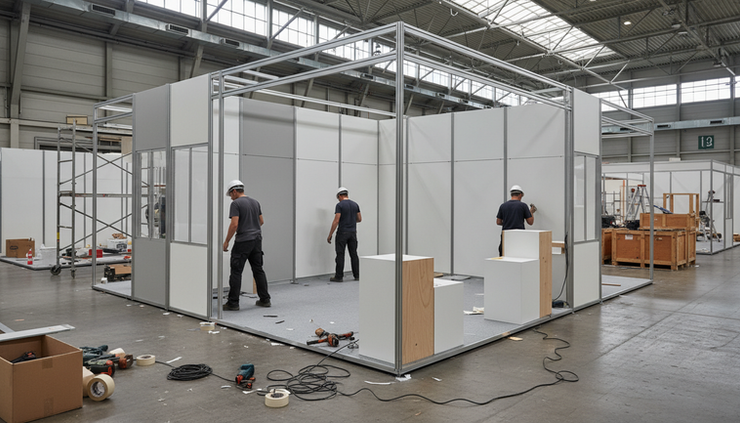
A modular exhibition stand utilizes standardized components. These include, for example, aluminum profiles, wall panels, modular frames, crossbeams, raised floors, and reusable parts. The result doesn't have to be plain. Modern modular stands can be designed with clean lines and significantly enhanced with graphics, lighting, and furniture.
Advantages
Usually cheaper than a purely individual stand.
Short setup time
Good reusability
Predictable processes
Ideal for small to medium-sized areas
Disadvantages
Less creative freedom
Shapes and heights are more dependent on the system.
There is a risk of confusion with standard solutions.
High brand impact requires additional design.
A modular system stand is suitable when budget, efficiency, and reusability are paramount. It is well-suited for information booths, regional trade fairs, recruiting events, or regular trade fair appearances with similar space requirements.
A well-designed modular booth doesn't look "off the rack." The key is how the system elements are combined. Graphic surfaces, clear lighting, and well-planned visitor flow make a big difference.
Hybrid construction combines efficiency and individuality
Hybrid construction combines standardized system elements with custom-made components. This could, for example, be a basic system structure with a special counter, a striking ceiling cornice, special product pedestals, or a custom back wall.
Advantages
A good balance between budget and impact
Parts of the stand can be reused.
Individual touches increase visibility
More flexible than a purely system-based setup
Often faster to implement than a completely custom stand
Disadvantages
Coordination between system components and special construction must be carefully planned.
Not every idea fits technically into every system.
Costs can increase if too many special parts are added.
Hybrid construction is often the best solution when the stand needs to have a high-quality appearance but doesn't require a completely custom design. It's suitable for companies that exhibit regularly but still want to showcase their own unique design language.
Many decisions are made right here: between individual stands, system stands, hybrid construction, row stands, and corner stands. The right combination of construction method and stand shape makes all the difference.
Stand designs determine visibility and visitor flow
Besides the construction method, the stand's shape plays a central role. It results from the location of the space in the exhibition hall and influences how visitors perceive the stand.
The row stand is compact and easy to calculate.
The row booth is bounded on three sides by neighboring booths or back walls and is only open at the front. It is often the most economical booth configuration and is well-suited for compact performances.
Strengthen
Clear front orientation
Good cost control
Easy to plan
Suitable for consultations, smaller exhibits and information points
borders
Visibility only from one direction
Less foot traffic from the side
Front design is particularly important
When it comes to the stall, the first impression from the aisle is crucial. A clear message, easily legible graphics, and an inviting entrance are essential.
Corner stalls offer more openness on the same footprint
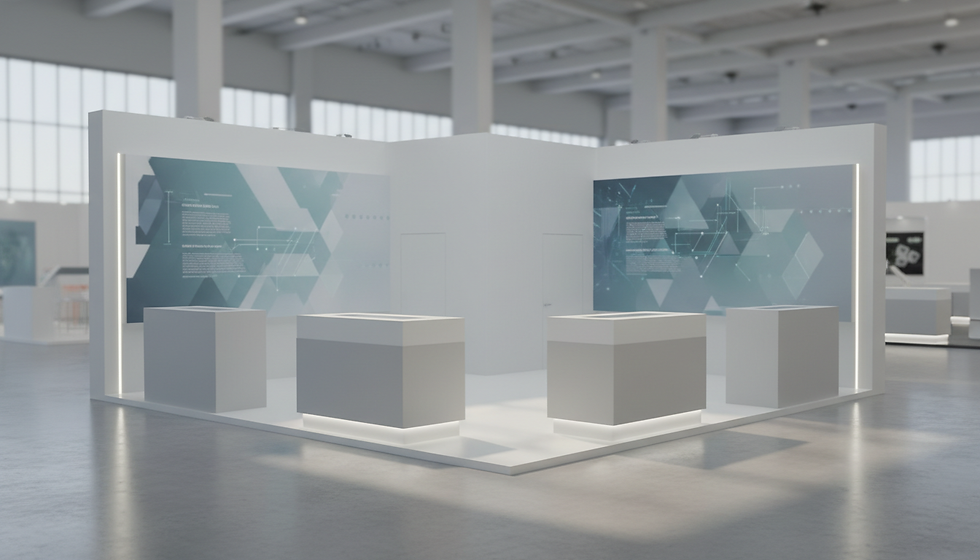
The corner booth is located at the end of a row of booths and is open on two sides of the aisle. This significantly increases its visibility. Visitors can approach the booth from two directions.
Strengthen
Better perception than in a row stall
More possible access points
A good compromise between budget and presence
Flexible visitor guidance
borders
Design must consider two open sides
Retreat areas need clear planning
Exhibits must not block access.
A corner stand is often the most sensible choice if you want more contact area but don't need a large island.
A headstand creates a strong presence at the end of the aisle
A headstand is open on three sides. It is located at the end of a row of booths and has a strong visual impact from a distance. Visitors can enter the booth from several directions.
Strengthen
High visibility
Open, inviting effect
Good visitor management possible
More space for product zones and discussions
borders
Higher budget for space and design
Less wall space for graphics
Open structures require order and clear areas.
A headstand is well suited for companies that want to have a visible presence without booking a completely freestanding space.
The island beach appears particularly open and representative.
The island booth is accessible from all four sides. It stands freely in the hall and offers the greatest openness. This makes it one of the most effective, but also most demanding, booth designs.
Strengthen
Maximum visibility
Visitor access from all directions
Powerful impact at major brand or product launches
Highly flexible room planning
borders
Usually a higher budget
High demands on design and order
No natural background
Personnel planning must cover all aspects.
An island stand is particularly worthwhile for large areas, high visitor traffic, or when the trade fair appearance is intended to have a strong visual impact. It requires a clear concept to prevent the openness from becoming confusing.

Comparison of exhibition stand types according to important criteria
The following table provides practical guidance. It does not replace planning, but it helps with initial classification.
criterion | Individual status | System status | Mixed construction |
budget | Rather higher, especially for special shapes and individual materials. | Rather low to medium, depending on size and features | Medium to high, depending on the proportion of special components |
Brand impact | Very high, as the design is freely developed. | Solid to good, heavily dependent on graphics, lighting and details. | High when individual touches are used strategically |
Reusability | Possible, but must be planned from the beginning. | Very good, as many elements are modular. | Good, especially with recurring basic elements. |
Construction period | Rather longer due to custom construction and individual components | Short to medium timeframe, as the systems are tried and tested. | Means, depending on special parts and system share |
flexibility | Excellent in design, less spontaneous in execution. | High in area matching within the system | Very good if the system and special construction are planned properly. |
A clear trend can be deduced from this:
When impact and uniqueness are the focus, there are many arguments in favor of individual stalls.
If budget, speed and reuse are more important, then the system state is the obvious choice.
If you want to combine presence and cost-effectiveness , mixed construction is often the best way to start.
Four practical questions will lead to the right decision.
The right standard isn't just a matter of taste. It arises from the objective, the available space, the budget, and the intended use. These four questions will help you decide.
What role does the trade fair play in the annual plan?
Is the trade fair a key event with high importance for sales, product launches, or partner relations? Then the booth should be conceived more as a stage. In this case, a custom-designed booth or a hybrid construction is usually the best option.
If the goal is regular attendance at several smaller events, a system booth might be the better choice. It's easier to adapt and reuse.
How much explanation does your offer require?
The more complex a product or service is, the more important zones become. These include reception, display areas, conversation areas, storage space, and, where applicable, media elements.
A single in-line booth may suffice if the processes are clear. For multiple product lines or high customer volume, corner booths, end booths, or island booths offer more flexibility.
How strong should the stall appear from a distance?
In crowded exhibition halls, the visual impact from a distance is often crucial. Tall structures, light, open edges, and clear sightlines help to attract attention.
A row stall needs a strong frontage. A corner stall utilizes two sightlines. End stalls and island stalls offer significantly more presence, but also require a well-thought-out concept to prevent the stall from appearing arbitrary.
Will the booth be used multiple times?
If you plan to use the stand across multiple trade fairs, reuse should be considered early in the planning process. This includes dimensions, graphics, transport, storage, and adaptability.
System-built and hybrid construction methods offer clear advantages here. Even a custom-designed stand can be planned for reuse, but this requires a modular approach right from the design stage.

After the decision, what matters is its safe implementation.
Once the construction method and stand design are finalized, the next important step begins: developing a concept suitable for trade fairs. Sketches are often insufficient for this. Only a spatial design reveals whether visitor flow is efficient, whether exhibits are correctly positioned, and whether the stand is easily understood from a visitor's perspective.
CA Messebau supports you after you've selected the right stand with a free 3D design . This allows you to see in advance how your exhibition stand will look. The fixed-price guarantee provides additional planning security because costs are calculated transparently.
If you're just starting out, you can first get an overview of CA Messebau's stand construction services . If you already have a trade fair date, a space available, or initial ideas, you can request a quote for your exhibition stand directly.
Choosing the right exhibition stand is a strategic decision.
The best trade fair booth isn't automatically the biggest, most expensive, or most eye-catching. It should suit your goal, your available space, your budget, and how you want visitors to interact with your offerings.
A custom-built stand excels when the goal is to create a unique brand experience. A modular stand impresses with its efficiency, predictability, and reusability. Hybrid construction combines both and offers a strong middle ground for many companies.
When it comes to booth design, the more open sides, the greater the visibility and visitor flow. At the same time, the demands on design, organization, and staffing increase. Addressing these points early on leads to better decisions and avoids costly adjustments shortly before the trade fair.


Comments