
Choose your exhibition stand size: 12, 20 or 50 m²? | CA Exhibition Construction
The right booth size determines the budget, impact, and flow of the event even before the trade fair begins. If the booth is too small, it quickly becomes crowded, conversations take place in the aisle, and products appear cramped. If it's too large, you pay for space that doesn't serve a clear purpose.
This guide shows you step by step how to determine the optimal size for your exhibition stand . It focuses on 12 m², 20 m², and 50 m² – three common sizes for first-time and returning exhibitors. You'll learn which objectives are best suited to which size, how stand layouts such as row, corner, end, and island affect the overall impact, and what to consider regarding your budget.
Here's how to choose the right stand size in six steps.
1. First, define the trade fair objective.
The booth layout shouldn't be decided on a whim. Start by asking yourself what you want your trade fair appearance to achieve.
Typical destinations include:
Gain new contacts
Meet existing customers in person
Show products live
Conducting consultations
to build a market presence
Partners or dealers receive
Address the press or specialist audience
For simply making initial contact with a few exhibits, a smaller space is often sufficient. If you want to explain several products, show samples, or conduct longer conversations, you'll need more space. With machinery, large exhibits, or a substantial reception area, the space requirement increases significantly.
A good starting point is this question: How many functions need to take place simultaneously at the booth? A reception area, a product zone, and a discussion area fit differently on 12 m² than on 50 m².
2. Plan the team, visitors, and movement area together.
Many exhibitors only consider furniture and products. However, the actual use of the space is driven by people. Their team needs room to stand, advise, and work. Visitors need space to arrive and decide whether to stay.
As a rough guide:
Stand size | Typical team size at the booth | Sensible use |
12 m² | 1 to 2 people | Reception, brief conversations, few exhibits |
20 m² | 2 to 4 people | Product presentation, consultation, small storage space |
50 m² | 4 to 8 people | Multiple zones, lounge, demonstration area, LED display |
These figures are not hard and fast rules. However, they help to identify bottlenecks early on. If three people are permanently stationed at the booth and several visitors need to be advised simultaneously, 12 m² quickly feels cramped. 20 m² already provides more freedom of movement. 50 m² allows for separate areas without interfering with conversations and foot traffic.
Anyone planning a booth size appropriate for a trade fair should not only think about square meters, but also about paths, sight lines and conversation situations.
3. Realistically compare 12 m², 20 m² and 50 m²
Each surface has a clear area of application. The crucial factor is that the size suits your goals.
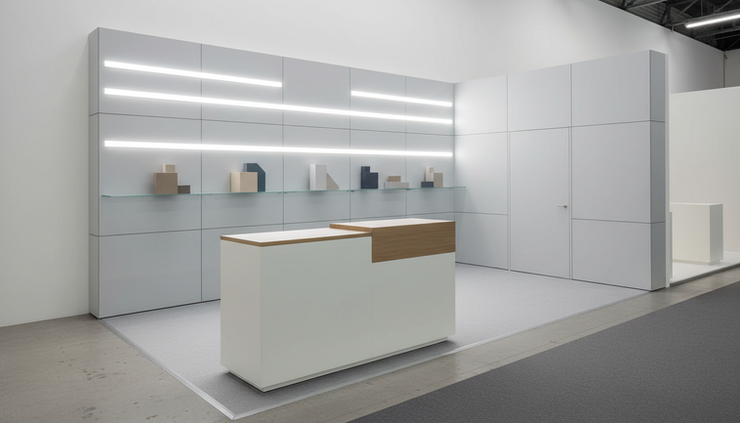
12 m² is suitable for a focused presentation
A 12 m² stand is ideal if you want a compact presentation. It's well-suited for first-time appearances, smaller budgets, or trade fairs where your main goal is to be visible and start conversations.
Typical elements on 12 m²:
Reception desk
Back panel with clear design
one to two product displays
small storage space
Standing table or compact seating option
CA Messebau offers fixed-price examples for 12 m² in Zone A starting from €5,800 . Prices for Zones B and C may be higher or can be calculated upon request. Important: These amounts refer to stand construction, not the stand rental fee charged by the event organizer.
A 12 m² booth works particularly well if you get straight to the point. Avoid too much furniture, overly broad product ranges, and large, enclosed meeting areas. The booth should remain open, clear, and easy to understand.
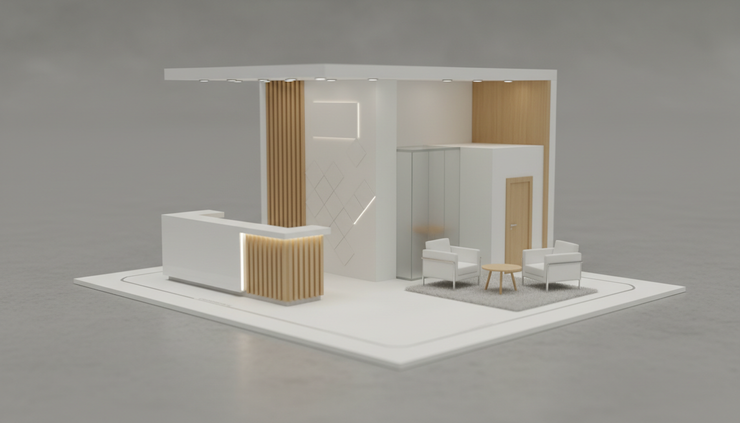
20 m² offers a good middle ground
A 20-square-meter booth is the ideal solution for many exhibitors. It offers enough space for presentations and discussions, while remaining manageable within budget. When you search for a 20-square-meter exhibition stand , you're usually looking for precisely this balance.
Typical elements on 20 m²:
Reception or information point
Product area
two conversation spaces
Storage space or small cabin
Monitor or smaller media area
clearly visible back or side wall
CA Messebau's fixed-price example for 20 m² in Zone A is €9,000 . Please note: higher prices or individual pricing may apply for Zones B and C.
20 m² is often suitable if your team consists of two to four people and you want to do more than just network; you also want to offer consultations. This size allows for clearer traffic flow than 12 m². Visitors can enter, view products, and have a conversation without blocking access.
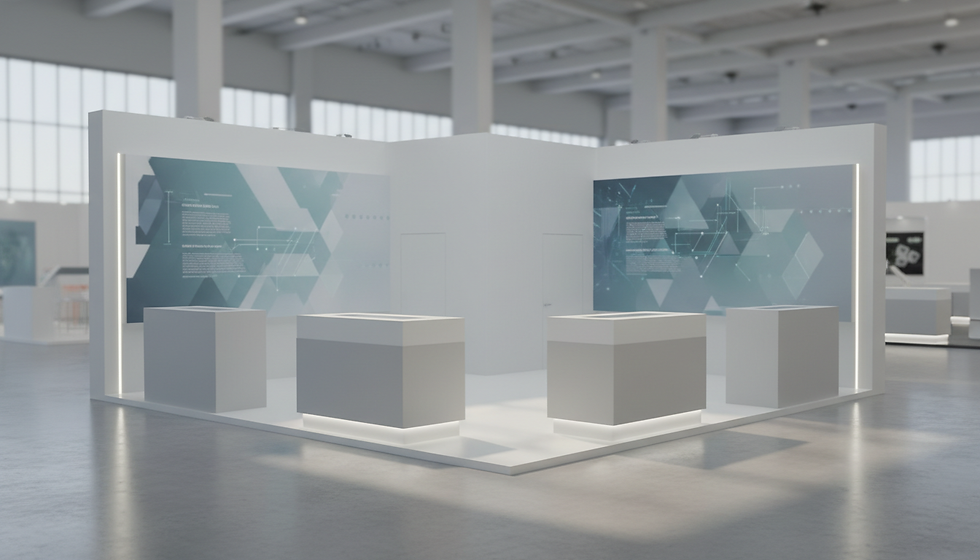
50 m² create space for brand impact and zones
50 m² is worthwhile if your stand needs to fulfill several functions simultaneously. Here you can neatly separate reception, product presentation, personal consultations, lounge, and media areas.
Typical elements in a 50 m² space:
generous reception
several product islands or demonstration areas
Lounge or semi-enclosed meeting areas
Storage or technical room
LED wall or large media surface
Clear walking routes with multiple entrances
CA Messebau offers fixed-price examples for 50 m² in Zone A starting from €22,500 . Prices for Zones B and C are higher or available upon request.
50 m² isn't automatically better. It's only useful if the additional space serves a purpose. Without a concept, a large booth can feel empty. With good zoning, it appears calm, sophisticated, and highly functional.

How the stand shape affects your required area
Besides the square footage, the layout plays a major role. When requesting a quote, layouts such as row, corner, end, and island are typically distinguished. The main difference lies in the open sides.
Lineup
A row stall is usually only open on one side of the aisle. It needs a strong frontage because visitors primarily perceive the stall from the front. This can work well in small spaces, as long as the back wall is clearly designed.
A 12-square-meter stall requires special discipline. The counter, message, and exhibits must all fit into a small space.
Corner stand
A corner stall is open on two sides. This often makes the same area feel more accessible. Traffic flow can be planned more effectively, and visibility increases.
For a 20 m² stand, a corner stand is often very attractive. It allows for better arrangement of the reception area and product zone, and attracts visitors from two directions.
Headstand
A headstand is open on three sides. It has a strong presence, but also requires more organization. Since there are fewer closed walls, storage space, graphic surfaces, and technology must be cleverly integrated.
In a space of 20 m² or 50 m², a headstand can be very inviting. It's well-suited if you want an open atmosphere for conversation.
Island stand
An island stall is open on all sides. It offers the greatest visibility but places high demands on design, layout, and technology. An island stall shouldn't look like a haphazard collection of furniture. It needs a clear center, eye-catching elements, and easily identifiable functions.
A 50 m² island stand can really shine. LED displays, a lounge area, and product zones can be used to create a fully immersive experience.
How to plan zones instead of just square meters
When choosing your exhibition stand space, simple zoning can be helpful. Mentally divide the stand into functional areas before discussing individual pieces of furniture.
These areas have proven successful:
Arrive
The first point of contact must be easy to understand. Reception, counter, or direct communication should be located near the hallway.
Show
Products, samples, or media need visibility. Good height, unobstructed view, and sufficient distance are important.
Speak
Consultations require a quiet environment. A standing table is often sufficient for small booths. A seating area is worthwhile for larger spaces.
stow
Bags, brochures, packaging, equipment, and personal belongings all need space. A lack of storage space quickly makes the stand look messy.
Works
Graphics, lighting, materials, and media surfaces shape the overall impression. These elements need space and shouldn't just be leftover areas.
A free 3D visualization helps you check these zones before ordering. You can see early on whether traffic flow is efficient, whether products are too close together, and whether the space suits your team. Especially with 12 m² or 20 m², this step saves a lot of time and effort later.
You can find more information about the scope of services in the Stand Construction section. If design is your main focus, it's also worth taking a look at Exhibition Stand Design .
How to correctly calculate your budget and booth rental costs
A common mistake is confusing stand rental and stand construction.
You typically pay the stand rental fee to the organizer. This fee covers the actual floor space on the exhibition grounds. Depending on the trade fair, hall, location, and stand design, the amount can vary.
Stand construction encompasses the structural implementation of your trade fair appearance. Depending on the offer, this includes, among other things, walls, flooring, lighting, graphics, furniture, storage space, assembly and disassembly.
The fixed-price examples mentioned by CA Messebau refer to stand construction:
Area | Zone A |
12 m² | from €5,800 |
20 m² | €9,000 |
50 m² | from €22,500 |
Zones B and C are more expensive or are calculated upon request. Therefore, always plan both budgets separately.
Stand rental from the organizer
Stand construction by the exhibition stand builder
Additional costs such as electricity, water, media connections or transport, if required.
Travel, hotel and staff
Exhibits, printed materials or technical content
This way you can determine early on what booth size is realistic. A smaller booth with good design can achieve more than a larger space without a clear concept.
When more space, LED lighting and lounge facilities are really worth it
Larger space makes sense when the additional area provides a concrete benefit. This is particularly often the case when you:
conduct several consultations simultaneously
Products that require explanation are shown
large exhibits present
Receiving existing customers in a calm atmosphere
would like to allow longer stays
a strong long-range effect in the hall is needed
LED displays can be effective in a 20 m² space if used strategically. In a 50 m² space, they create greater visibility and help make messages visible even from a distance. Crucially, they must be integrated into the overall booth design. A large media surface without a clear message wastes budget and attracts attention.
A lounge is worthwhile if conversations tend to be longer or more confidential. It's usually too much for 12 m². A small seating area can be useful for 20 m². A lounge can be integrated much more pleasantly into a 50 m² space without taking up product display area.

FAQ on choosing the exhibition stand size
What booth size makes sense for first-time exhibitors?
For first-time exhibitors, 12 m² or 20 m² are often suitable. 12 m² is sufficient for a compact presentation with a clear message. 20 m² offers more space for consultations, products, and storage.
Is a 20m² exhibition stand large enough for consultations?
Yes, if the space is well-planned. A 20-square-meter booth can accommodate a reception area, product presentation, and one or two meeting areas. Short distances and clearly defined storage space are essential.
What is the difference between booth rental and booth construction?
You pay the booth rental fee to the trade fair organizer for the rented space. Booth construction includes the design and physical implementation of the exhibition stand. You should plan these two costs separately.
Which standing position is best?
It depends on location, objective, and budget. A row stall is compact and clearly defined. A corner stall offers more openness. End and island stalls appear more prominent but require particularly careful planning.
Does 3D planning help with deciding on the size?
Yes. A free 3D preview shows you whether the space works before you order. You can see early on whether products, team, visitors, and meeting areas fit together effectively.
The next step towards finding the right standing surface
When choosing between 12 m², 20 m², and 50 m², don't start with the size. Start with your goals, team, products, and communication needs. The appropriate size will then become much clearer.
For a compact entry point, 12 m² is often sufficient. 20 m² offers plenty of flexibility for consultations and product presentations. For multiple zones, LED lighting, a lounge area, and a stronger presence, 50 m² is the ideal foundation.
If you would like to review your stand size with a concrete concept, you can request a quote for your exhibition stand directly. CA Messebau will help you to clearly define the required space, stand shape, design, and budget before registration.
Meta Title: Choosing the right exhibition stand size: 12, 20 or 50 m²? | CA Exhibition Construction
Meta Description: Which exhibition stand size suits your goals? Practical guide to 12 m², 20 m² and 50 m² stands, stand designs, budget, stand rental and free 3D planning.


Comments